
The forex market is open 24 hours a day, five and a half days a week, but that doesn’t mean you should trade all 24 hours. The best times to trade are when the most money is flowing through the pairs you trade, and that comes down to the trading sessions. In this guide I’ll explain the four sessions, why the overlaps matter, and which pairs to focus on in each.
The four trading sessions
The sun rises in the east, so the trading day starts in the Asia-Pacific region: first New Zealand, then Sydney, then Tokyo. Europe follows, with Frankfurt, Paris and London, and New York is the last major centre to open. Each centre’s trading day starts around 8am local time, although the traders themselves are usually in earlier.
| Session | Main centres | Rough hours, UK time | Rough hours, New York time |
| Sydney | Sydney, Wellington | 10pm – 7am | 5pm – 2am |
| Tokyo (Asian) | Tokyo, Singapore, Hong Kong | Midnight – 9am | 7pm – 4am |
| London (European) | London, Frankfurt, Paris | 8am – 5pm | 3am – 12pm |
| New York | New York | 1pm – 10pm | 8am – 5pm |
These times shift by an hour or so when the clocks change, and the UK, US and Australia change on different dates, so treat them as a guide and check your platform.
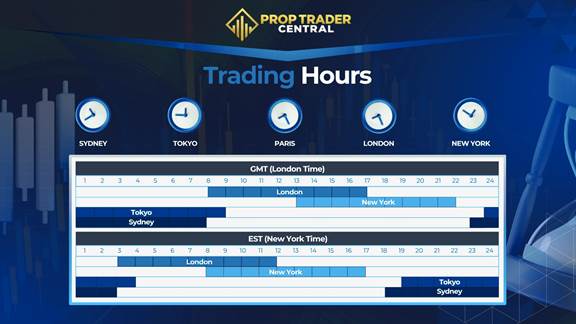
Not all sessions are equal. London is the world’s biggest FX trading centre by a distance. The UK handles 38% of all forex turnover, with the US a distant second at 19% (BIS, 2025). Together with Singapore and Hong Kong, these four centres handle three quarters of all FX trading.
The overlaps: when liquidity peaks
The most important times are when two sessions overlap, because that’s when the most traders, banks and money are active at once.
- Asia into London, around 8am UK time. London opens while Tokyo is still trading, so there’s a short overlap at the start of the European day.
- London and New York, around 1pm to 5pm UK time (8am to 12pm New York). The two biggest centres in the world are open together. If you can day trade during these hours, this is usually the best window of the day.
Why does liquidity matter so much? More players in a market means more activity, tighter spreads and, in my experience, technical levels that hold up better. That’s especially true if you follow trends.
Which pairs to trade in each session
Trade the currencies whose home markets are awake.
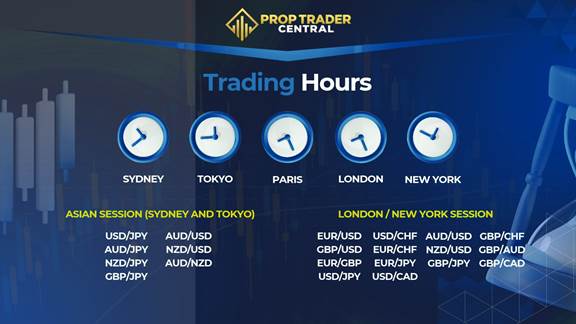
| Session | Pairs to focus on |
| Asian | Pairs with the Australian dollar, New Zealand dollar and Japanese yen, e.g. AUD/NZD, AUD/JPY, AUD/USD, USD/JPY |
| London | European currencies against the US dollar and against each other, e.g. EUR/USD, GBP/USD, EUR/GBP, EUR/JPY |
| London–New York overlap | The majors: EUR/USD, GBP/USD, USD/JPY, USD/CAD |
The same applies beyond forex. Would you really want to trade the DAX, Germany’s stock index, in the middle of the Asian session, or the Dow while New York is asleep?
You also don’t need to trade all 28 pairs. Pick a few that suit the session you can trade, and master them.
Pick your sessions and stick to them
Just because the market is open doesn’t mean you should jump in. Some times of day are best avoided altogether: the quiet hours after New York closes, when liquidity is thin and spreads widen, and the daily rollover. Decide which session or sessions you’ll trade, write them into your trading plan, and stick to them.
Trading sessions and prop firms
Session choice matters on a funded account too. Thin markets mean wider spreads and more slippage, and both count against your daily loss limit. Some firms also restrict holding trades over the weekend or trading around major news, which affects when you can trade. Check the rules first, which is exactly what we help with at Prop Trader Central.
Frequently asked questions
What are the forex trading sessions? Sydney, Tokyo (Asian), London (European) and New York.
What is the best time to trade forex? For most pairs, the London–New York overlap, roughly 1pm to 5pm UK time, when the two largest centres are open together.
Is the forex market open 24 hours? Yes, from Sunday evening to Friday evening (UK time), but liquidity varies a lot through the day.
Which pairs should I trade in the Asian session? Pairs with the Australian dollar, New Zealand dollar and Japanese yen, such as AUD/JPY and AUD/NZD.
Which is the biggest forex trading centre? London, with 38% of global FX turnover in 2025.
Watch the lesson
This article goes with lesson 14 of the Prop Trader Central Masterclass, Trading Timezones. https://youtu.be/y4dX7rRP4H4
Trading forex and CFDs involves a high level of risk and may not be suitable for everyone. Most retail accounts lose money when trading CFDs. This article is for educational purposes only and is not financial advice.