
Why do prices go up, and why do they go down? I’m sure you’re shouting at the screen: more buyers than sellers, or more sellers than buyers. And of course that’s true. But it’s worth going a little deeper, because this idea is the foundation for almost everything we do as traders: supply and demand, support and resistance, liquidity zones, order blocks and more. In this article I’ll cover the two forces that move every market, and the auction system that forex and CFDs run on.
Supply and demand: the two forces on every price
It doesn’t matter what you trade: forex, CFDs, shares, or apples and oranges at the market. Two forces are always acting on the price.
Supply. When supply rises, there’s more on offer, so sellers have to drop their price to shift what they’re selling. When supply falls, buyers have to compete for what’s left, and the price rises.
Demand. When demand rises, buyers compete harder and sellers can command a better price, so the price goes up. When demand falls, sellers have to cut their price to find buyers.
| Price tends to… | |
| Supply up | Fall |
| Supply down | Rise |
| Demand up | Rise |
| Demand down | Fall |
Pretty basic economics, but it’s exactly what’s happening in forex, commodities and CFDs every second the market is open.
Equilibrium: when the market goes sideways
Sometimes supply and demand are in balance. Neither side is winning, so price doesn’t really go anywhere. On the chart, that’s a consolidation or range.
You often see this after a big, violent move. Price has run as far as the imbalance can push it, the market accepts the new price, and things calm down into a range until the next imbalance comes along.

The auction system
All financial markets, whether forex, crypto or commodities, work as an auction. Think of a fine-art auction, with bidders raising their paddles. The more buyers there are, the higher the price goes, and the winner gets the deal. Financial markets are no different.
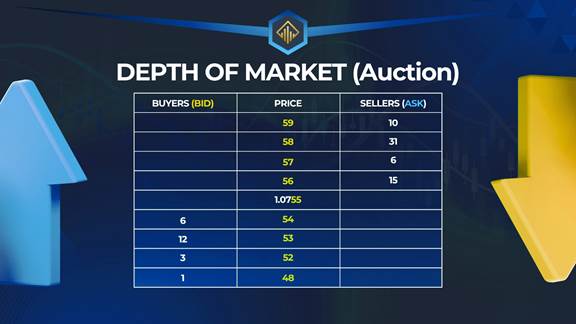
At any moment there’s a current price, where buyers and sellers are meeting and trades are happening. Either side of it is a ladder of prices:
- Below the current price, buyers are waiting with bids, hoping to buy cheaper.
- Above the current price, sellers are waiting with offers, hoping to sell higher.
These waiting orders are known as liquidity pools, and the full ladder is called the depth of market. As traders, much of what we do is try to work out where these pools of orders are sitting, because they give us clues about where price may go next.
One important point: in forex you can’t actually see the depth of market on most broker platforms. It’s an enormous, decentralised market, turning over around $9.6 trillion a day according to the Bank for International Settlements, so the orders are spread across many venues. Instead we use the charts to find where liquidity is likely to be. Human behaviour tends to repeat itself, and it leaves footprints on the chart.
A worked example: how big orders move price
Let’s use a simplified depth of market for EUR/USD. The real numbers are far bigger, but the principle is the same. The current price is 1.0755, and on the offer side there are:
| Price | Lots offered |
| 1.0759 | 10 |
| 1.0758 | 31 |
| 1.0757 | 6 |
| 1.0756 | 15 |
Buyer one. Say I’m a big bank and I need to buy 30 lots to cover a dollar exposure. I put in a market order to buy 30 lots. I take all 15 lots at 1.0756, all 6 at 1.0757, and 9 of the 31 at 1.0758. My order is filled, but I’ve moved the price up three pips doing it, and 22 lots are left at 1.0758.
Buyer two. Another institution wants 40 lots and is willing to pay up to 1.0759. They take the remaining 22 lots at 1.0758 and the 10 at 1.0759. That’s 32 lots. There’s nothing left at their limit, so the last 8 lots sit as a new bid at 1.0759, and new offers start to appear above.
That’s how buying and selling moves price: when one side is bigger than the orders waiting on the other side, it eats through the ladder.
Slippage: why you don’t always get the price on the screen
Now flip it around. Say I want to sell 40 lots, but I won’t go lower than 1.0748. I hit the bids below the market and fill 22 lots on the way down to 1.0748. The other 18 lots I can’t sell, so they sit as an offer at 1.0748.
Look at the gap on the way down, though. There were no bids at 1.0751, 1.0750 or 1.0749. Price jumped straight past them.
That’s slippage. Just because you see a price on the screen when you press buy or sell at market doesn’t mean you’ll get it. A market buy takes the offers above; a market sell hits the bids below.
Slippage is most likely when liquidity dries up:
- Around the daily rollover, at the end of the trading day (about 23:59 server time on many platforms).
- Around big news events, when orders get pulled and prices can skip whole levels.
With fewer orders in the depth of market, prices move more violently and some prices are skipped altogether.
Why this matters on a prop firm account
On a funded account, slippage around news or rollover can turn a planned loss into a bigger one and eat into your drawdown limit. Knowing how the auction works helps you:
- Be careful with market orders around major news and rollover.
- Understand why price often reacts at levels where orders are likely to be waiting.
- Read consolidation as balance, and a breakout as a new imbalance.
Frequently asked questions
What drives the forex market? Supply and demand. When buyers outweigh sellers, price rises; when sellers outweigh buyers, price falls. When they balance, price ranges.
What is a liquidity pool? A cluster of waiting buy or sell orders at prices above or below the current market.
What is depth of market? The ladder of waiting bids and offers at each price. Most forex platforms don’t show it, so traders use charts to estimate where liquidity sits.
What is slippage? Getting filled at a worse price than you saw on screen, because there weren’t enough orders at that price to fill you.
When is slippage most likely? When liquidity is thin, such as around major news releases and the daily rollover.
Watch the lesson
This article goes with lesson 22 of the Prop Trader Central Masterclass, What Drives the Market.
Trading forex and CFDs involves a high level of risk and may not be suitable for everyone. Most retail accounts lose money when trading CFDs. This article is for educational purposes only and is not financial advice.