Boy, do I know about the cycle of doom. When I moved from the trading pits in the City of London onto the screens, around 2005, I fell straight into it. I spent about 18 months bleeding money before I got myself out. Since then I’ve taught tens of thousands of students, and more often than not, when they start with me, they’re stuck in it too. I think it may be the number one reason traders fail. In this article I’ll explain what the cycle of doom is, and the three things that keep you out of it.
What is the cycle of doom?
To trade for the long term, you need a proven strategy. You can build your own, buy one off the shelf, or follow one of mine, but you need one. (Remember the three-legged stool: strategy isn’t the most important part of trading, but you can’t do without it.)
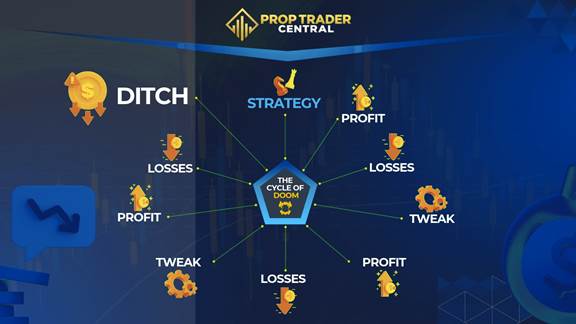
Here’s how the cycle usually plays out:
- You start trading your strategy and make money. It feels great. You’re earning what you made in your day job, in a couple of hours, from your home office. What a job!
- Then the losses come. They always do. “Hang on, this isn’t what I signed up for.”
- You tweak the strategy. You add an RSI filter: if only you hadn’t bought above 70 or sold below 30, you’d have avoided those losses.
- You make money again. Now you’ve really cracked it. You’re ready to tell the boss where to go and trade from the beach.
- The losses come back. So you add a Bollinger Band, or another moving average. In it goes.
- Eventually, you ditch the whole thing. The strategy’s rubbish, the person who sold it to you is a scammer, Andrew Lockwood doesn’t know what he’s talking about. It can’t be you, so it must be the strategy. Off you go to find a new one.
And round and round you go. Most struggling traders are on a constant hunt for the holy grail: in chat rooms, on forums, trying whatever someone else says is better. Meanwhile they keep losing money and failing prop firm challenges.
Here’s the truth: the holy grail doesn’t exist. Always looking over the fence for the next strategy is not how anyone makes it as a trader.
Three ways to avoid the cycle of doom
1. Have realistic expectations
Trading is not a free cash machine where you put your card in and the money comes out. It takes time and dedication, and it’s an ongoing journey. We never stop learning.
So what’s a realistic return? In my view, 3% to 5% a month is a really healthy return on an account.
The problem is that on a small account that doesn’t feel like much. 5% on a $5,000 account is $250 a month, and you won’t give up your day job on that. So traders push for huge returns, take too much risk and blow up.
This is where prop firms change everything. On a funded account, those same realistic returns become meaningful:
| Account size | 3% a month | 5% a month |
| $5,000 | $150 | $250 |
| $100,000 | $3,000 | $5,000 |
With realistic targets, there’s far less pressure on each trade. You can focus on protecting the account and let it grow over time, and you can scale up from there. Don’t try to knock it out of the park on one trade. Keep your expectations realistic and your trading becomes a lot less stressful and a lot more productive.
2. Think in terms of the law of large numbers
I used to see parents at the playground checking their positions on their phones, as if everything depended on that one trade. It doesn’t. The trade you’re in right now, or the one you’re about to take, is pretty much irrelevant to the big picture.
We all have winning trades and we all have losing trades. What matters is the probabilities across a large number of trades. If your strategy has an edge, a run of losers doesn’t mean it’s broken. A run of winners should be just around the corner. We go into this in much more detail in the lesson on probabilities and the law of large numbers.
3. Backtest your strategy fully
Backtesting may be one of the most boring parts of trading, but it’s also one of the most crucial. Before you trade real money, or take on a prop firm challenge, you should know your strategy inside out:
- What win rate to expect
- How many losses in a row it can produce
- How many wins in a row it can produce
Then, when a losing run comes, it won’t surprise you, and you won’t be tempted to ditch a perfectly good strategy. We have a whole lesson on backtesting because it’s so important.
The cycle of doom and prop firm challenges
Every time you change strategy in the middle of a challenge, you reset what you know about it. You’re no longer trading a tested edge, you’re experimenting with the firm’s drawdown limit. Pick a backtested strategy, set realistic targets, and give it enough trades to show its edge.
Frequently asked questions
What is the cycle of doom in trading? The habit of tweaking or replacing your strategy every time it has a losing run, so you never stick with one long enough to profit from its edge.
How do I get out of the cycle of doom? Set realistic expectations, judge your results over a large number of trades, and fully backtest one strategy so you know what to expect from it.
What is a realistic monthly return in trading? In my view, 3% to 5% a month is a very healthy return, and on a funded account it can be a meaningful income.
Is there a holy grail trading strategy? No. Every strategy has losing runs. Consistency comes from sticking with a tested edge and managing risk.
Watch the lesson
This article goes with lesson 24 of the Prop Trader Central Masterclass, Cycle of Doom. https://youtu.be/Se_GmBGfTgQ
Trading forex and CFDs involves a high level of risk and may not be suitable for everyone. Most retail accounts lose money when trading CFDs. This article is for educational purposes only and is not financial advice.