
Most retail traders lose money. In the UK, CFD brokers have to publish the share of their retail accounts that lose, and the figures are often 70% to 80% or more. I believe the number one reason is simple: most people don’t treat trading as a business. They come in for a bit of fun, or to get rich quick, and end up donating their money to the markets. In this article I’ll show you how to build a trading business plan, including the trading plan that sits inside it, so you start treating this like the serious business it is.
Why you need a plan
If you were opening a bakery or a garage and needed funding, the bank’s first question would be: “Show us your business plan.” They’d want to see your objectives, your risks, your route to get there and your numbers.
Trading is no different. The beauty of it is that you don’t need vast amounts of capital any more, especially with prop trading. But you do need a plan.
You may know the five Ps: proper preparation prevents poor performance. The athlete on the start line has put in months of work before the race. The football team has trained all week before Saturday’s match. And of course: if you fail to plan, you plan to fail. You wouldn’t set off on a long drive without knowing your route.

Your plan should be written down, not kept in your head. Review it every week if you can, or at least every fortnight. Sunday, before the trading week starts, is a good time.
Start with your goals and objectives
The most important part of the plan is why you’re doing this. Everything else is built around it.
- Do you want a second income alongside your job?
- Is your aim to eventually trade full time?
- Or are you looking for a longer-term return on investment?
Your plan becomes the roadmap for growing your trading business and staying on track. It also sets out how you’ll check your progress, so you can adapt as markets change, and it gets your finances straight so there are no surprises down the line.
Do a SWOT analysis
At the start of your plan, do a SWOT analysis: your strengths, weaknesses, opportunities and threats. It only works if you’re completely honest with yourself. As with any problem, admitting your shortcomings gets you halfway to fixing them. These are prompts, not a checklist: it’s your business, so list what applies to you.
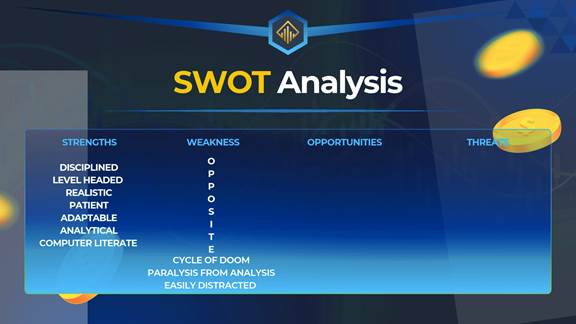
Strengths might include being disciplined, level-headed, realistic, patient, adaptable, analytical and comfortable with technology.
Weaknesses might be the opposite of any of those. Others to look out for:
- Being prone to the cycle of doom: constantly tweaking your strategy or hunting for a new one. Many of my students were in it without knowing. Once they saw it, they could get out.
- Paralysis by analysis: analysing so much that you’re too scared to place the trade.
- Being easily distracted: if so, build routines to deal with it.
Opportunities:
- Forex and CFDs are accessible, with plenty of leverage available.
- Prop trading lets you control large amounts of capital for a small outlay, a huge opportunity if you know how to trade properly.
- Free demo accounts let you test strategies. People say demo doesn’t show the emotions, and maybe that’s right. But if you can’t make money on demo, you won’t make it live.
- Education, mentoring and trading communities, so you’re not doing this alone.
Threats:
- Brokers and prop firms can go under. Use regulated brokers, consider spreading your money, and check that prop firms are well funded and paying out regularly.
- IT and internet failures. Have a backup plan.
- Weekend gaps. Prices can open on Monday well away from Friday’s close, and occasionally a black swan event hits. Don’t risk too much over the weekend.
- The need to earn. If you’re behind on your goals and need the money, you may be tempted to take on too much risk.
- Time. How much can you really give to trading?
- Your partner. Are they on board? Be honest with them. It works far better when it’s something you agree on together.
What to include in your business plan
- Goals and objectives at the top: second income, investment or full-time income.
- Financial allocation. How much of your savings are you putting in, including prop firm challenge fees and broker deposits? Never go in with a bottomless pit of money. That’s very damaging for the mind.
- Milestones and timelines. Three months, six months, a year or longer. Check whether you’re on track as you go.
- Education budget. Courses, group or private mentoring.
- Equipment. Laptop, screens, backup PC or phone. Honestly, two screens is plenty for most traders.
- Software, such as backtesting tools.
- A reserve fund in case things don’t go to plan.
- How you’ll monitor performance. I thoroughly encourage a trade journal, whether a spreadsheet or pen and paper.
- Your monthly target, for example 3% or 4% a month. On a large funded account, that’s a decent income. Set it and stick to it; don’t decide halfway through that it’s not enough and start chasing 10%.
- How and when you’ll pay yourself. Time-based or percentage-based withdrawals. There’s no point trading if you never take a payment.
The trading plan: your strategy, written down
Inside the business plan sits your trading plan. This is about how you actually trade.
Strategy development
- Where’s your strategy coming from: off the shelf, copy trading, your own, or someone else’s?
- Are you a swing trader, a day trader or a scalper? Don’t keep switching because you’re not hitting your monthly target.
- How will you backtest it: dedicated software, TradingView or MetaTrader’s tools, or pen and paper? And when will you go live?
The strategy itself
- Name your strategy. I’m a big believer in this. It’s about ownership. Mine have names like the Boomerang strategy and the Naked Trading strategy, and they’ve become part of my business.
- Which markets you’ll trade. Focus on a few currency pairs and get good at them. Don’t keep adding more pairs because the ones you trade aren’t working.
- Timeframes: 5-minute, 15-minute, 1-hour, 4-hour, daily, weekly.
- Indicators and price patterns: MACD, Bollinger Bands, RSI, candlestick patterns and so on.
- Entry rules, exit rules, take-profit and stop-loss placement.
Risk rules
- Maximum risk per trade. I don’t think anything much above 0.25% to 0.5% per trade is advisable. I’m a big believer in 0.25%.
- Target risk-to-reward. 10:1, 2:1 or 1.5:1? Your backtesting will show what suits your strategy.
- Maximum combined risk. Lots of markets are correlated. Five trades at 0.25% each is 1.25% at risk. Set a cap.
- Weekend policy. Will you close on Friday, or Thursday, or hold over the weekend? If your plan says close, you close, even if the trade is losing.
Writing all of this down keeps you away from random decisions, which is exactly what we want to avoid.
Sign a daily declaration
One more thing I strongly encourage: a short declaration you sign and date every morning, as part of your pre-market routine. For example:
- I will never risk more than my set amount per trade.
- I will always use a stop loss.
- I will never move my stop loss for fear of it being hit.
- I will stop trading for the day if my account falls by X%.
- I will not copy a trade signal just because it looks good.
- I will not take a trade outside my trading rules.
Add to it or take things away. You may think you don’t need it, but it will make a real difference. And if you keep signing it and keep breaking it, that tells you something important about your trading psychology.
Why this matters for prop traders
Prop firms have their own hard rules: daily loss limits, maximum drawdown and so on. A written plan with your own risk rules, set inside the firm’s limits, is what stops one bad day from ending your account. If you want to give up your day job in a year or two, you have to take this seriously. It really is as simple as that.
Frequently asked questions
What should a trading business plan include? Your goals, your financial allocation, milestones, costs, a reserve fund, how you’ll track performance, your monthly target and how you’ll pay yourself, plus a trading plan setting out your strategy and risk rules.
What’s the difference between a business plan and a trading plan? The business plan is the big picture of your trading business. The trading plan is the detail of how you trade: strategy, markets, timeframes, entries, exits and risk.
How often should I review my trading plan? Weekly if you can, or at least every two weeks. Sunday before the market opens works well.
How much should I risk per trade? In my view, no more than about 0.25% to 0.5% of your account per trade.
What is a SWOT analysis for traders? An honest list of your strengths, weaknesses, opportunities and threats as a trader.
Watch the lesson
This article goes with lesson 25 of the Prop Trader Central Masterclass, The Business Plan. https://youtu.be/xuM75ZEB7YY
Trading forex and CFDs involves a high level of risk and may not be suitable for everyone. Most retail accounts lose money when trading CFDs. This article is for educational purposes only and is not financial advice.