
If you’ve followed me over the years, you’ll have heard me say that I see myself as a risk manager first and a trader second. Amateurs think about how much they can make. Professionals think about what they could lose, and about protecting their capital. In this article I’ll cover why the stop loss comes first, how to size your trades so every loss is the same size, and how risk-to-reward means you don’t need to be right most of the time.
Risk is part of everything we do
We take risks every day. Driving to work carries risk, but we judge the benefit to be worth it. A corner-shop owner takes a risk every time they buy stock they might not sell. Trading is no different, except that professionals think about the risk first.
Always use a stop loss
As I said in an earlier lesson, the stop loss is the most important order you’ll ever use. Some traders say you should keep your stop in your head. I don’t agree. I always place my stop loss at the same time as I open the trade.
That way you know your maximum loss on the trade (allowing for any slippage) before you’re in it. And it lets you size your position to suit where the stop needs to go.
Fixed lots vs variable lots
Some traders use a fixed lot size: one lot, or half a lot, on every trade. The problem is that the lot size then dictates your stop, so you end up putting your stop where it fits the money rather than where it makes sense on the chart.
I use a variable lot size. You decide where the stop should go based on the price action, then adjust the size of the trade so the loss, if the stop is hit, is always the same amount.
Worked example
Take a $10,000 account trading EUR/USD, risking 0.5% per trade. That’s a maximum loss of $50 on any trade. On one standard lot, a pip is worth $10.
- With one standard lot, a $50 loss allows a stop of just 5 pips. That’s probably too tight.
- Say there’s a key level 4 pips away and you want your stop safely beyond it, at 10 pips. Double the stop means half the size: 0.5 lots. The loss is still $50.
The formula is:
\text{Lot size} = \frac{\text{Account} \times \text{Risk \%}}{\text{Stop (pips)} \times \text{Pip value per lot}}
More examples
On a $100,000 account at 0.5% risk, the maximum loss is $500. For pairs with USD as the quote currency (a pip is $10 per standard lot):
| Stop loss | Trade size |
| 50 pips | 1.00 lot |
| 60 pips | 0.83 lots |
| 200 pips | 0.25 lots |
The pip value changes with the quote currency. For pairs quoted in Canadian dollars, such as AUD/CAD or EUR/CAD, a pip on one lot is worth about $7.14 when USD/CAD is at 1.40. So a 20-pip stop with $500 at risk works out at about 3.5 lots. Your platform or a position-size calculator will do this maths for you.
Your risk grows (and shrinks) with your account
Because you risk a percentage, the dollar amount changes with your balance. If the account grows to $125,000, 0.5% becomes $625 per trade. If it falls to $90,000, it drops to $450. That’s compounding at work: you risk more as you win and less as you lose.
Risk-to-reward (R:R)
Just like deciding whether the drive to work is worth it, every trade should weigh the risk against the reward. Traders often call one unit of risk “1R”.
| Risk | Reward | Risk-to-reward |
| $100 | $100 | 1:1 |
| $100 | $200 | 2:1 |
| $100 | $300 | 3:1 |
| 0.5% | 0.5% | 1:1 |
| 1% | 3% | 3:1 |
You don’t need to be right most of the time
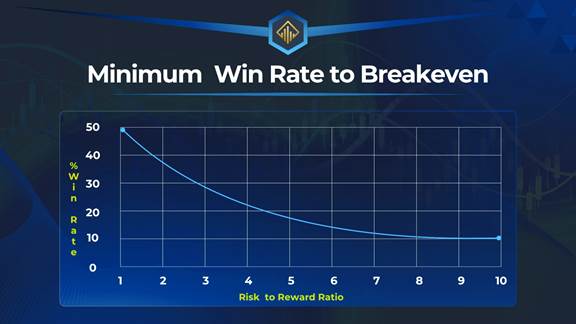
A lot of new traders think they need to be right all the time, and they get deflated by every loss. With a positive risk-to-reward, you don’t. Here’s the win rate you need just to break even:
| Risk-to-reward | Break-even win rate | Roughly… |
| 1:1 | 50% | 1 in 2 trades |
| 2:1 | 33% | 1 in 3 trades |
| 3:1 | 25% | 1 in 4 trades |
| 4:1 | 20% | 1 in 5 trades |
| 5:1 | 17% | 1 in 6 trades |
| 10:1 | 9% | 1 in 11 trades |
So why not always go for 5:1?
This is where trading gets more complicated, and the complication is you.
I’d love to take 5:1 winners all day. But going for bigger targets means taking a lot more losing trades along the way. How will you feel taking loss after loss while you wait for the big one? Some people would rather have more winners with smaller returns. Others are patient and disciplined enough to wait for the home runs, which don’t come often but feel great when they do.
The right risk-to-reward is the one that fits your strategy and your personality. And when someone in a chat room boasts about an 8:1 winner, remember that you don’t hear about the seven losers before it.
Risk management on a prop firm account
Prop firms are, first and foremost, risk managers. Their daily loss and maximum drawdown limits are there to see whether you manage risk like a professional. Using a stop loss on every trade, fixing your risk as a small percentage and sizing each position to fit is exactly what keeps you inside those limits.
Frequently asked questions
How do I calculate my position size? Divide the amount you’re willing to risk by the stop loss in pips multiplied by the pip value per lot. For example, $50 ÷ (10 pips × $10) = 0.5 lots.
What is a variable lot size? Adjusting your trade size on each trade so that, wherever your stop goes, the amount you’d lose stays the same.
What is a good risk-to-reward ratio? There’s no single answer. Higher ratios need fewer winners but bring more losing trades. Choose one that fits your strategy and personality, and check it with backtesting.
What win rate do I need with a 2:1 risk-to-reward? About 33%, or one winner in every three trades, to break even.
Should I always use a stop loss? In my view, yes, placed at the same time as you open the trade.
Watch the lesson
This article goes with lesson 27 of the Prop Trader Central Masterclass, Amateurs Trade, Professionals Manage Risk. https://youtu.be/-svv173WKjs
Trading forex and CFDs involves a high level of risk and may not be suitable for everyone. Most retail accounts lose money when trading CFDs. This article is for educational purposes only and is not financial advice.