There’s a famous line, often credited to Albert: compound interest is the eighth wonder of the world; those who understand it earn it, and those who don’t pay it. If you’ve ever let a credit card balance run, you’ll know the painful side of it: the debt grows month after month even if you don’t buy anything new. In trading, we can make compounding work for us instead. In this article I’ll show you how.
Fixed lots vs compounding
There are two broad ways to size your trades:
- The fixed approach: you trade the same amount every time, based on your starting balance.
- The compounding approach: you risk a percentage of your current balance, so your trade size grows as the account grows.
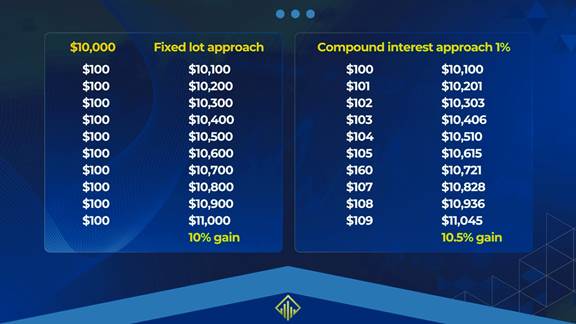
Here’s the difference over ten winning trades in a row, starting with $10,000 and making 1% per trade. Ten winners in a row is hard to get, but it shows the idea:
| Trade | Fixed ($100 a trade) | Compounding (1% of balance) |
| 1 | $10,100 | $10,100 |
| 2 | $10,200 | $10,201 |
| 3 | $10,300 | $10,303 |
| 5 | $10,500 | $10,510 |
| 10 | $11,000 | $11,046 |
| Gain | 10.0% | 10.5% |
Over ten trades the difference is small. Over months and years, it becomes huge.
Why compounding is a no-brainer
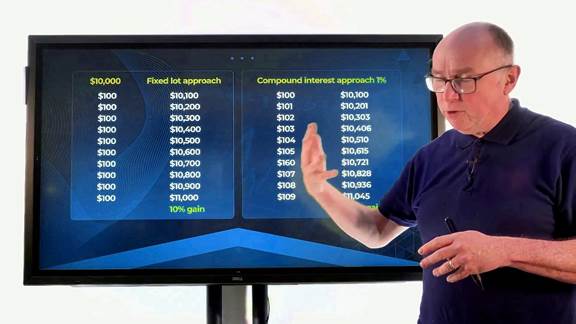
The real beauty of compounding is how it behaves through winning and losing runs. We all have both.
- In a winning streak, your balance grows, so you automatically risk a little more on each trade, and make more.
- In a drawdown, your balance shrinks, so you automatically risk a little less, protecting what’s left.
It works for you when you’re winning, and it protects you when you’re losing.
What realistic growth looks like
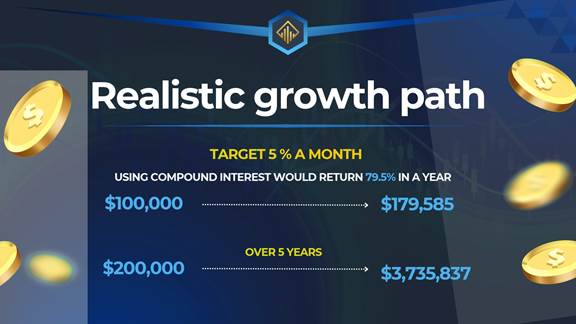
I always say 3% to 5% a month is realistic and achievable. Let’s take 5% a month, compounded, purely as an illustration. Making 5% every single month is a tall order for anyone.
| Starting balance | After 1 year | After 5 years |
| $5,000 | $8,979 | $93,396 |
| $100,000 | $179,586 | $1,867,919 |
| $200,000 | $359,171 | $3,735,837 |
That’s about 79.6% growth in a year. Turning $5,000 into over $93,000 in five years is not bad at all, but it’s not exactly enough to retire on.
Why prop firms change the maths
This is where prop trading comes in. With a funded account you can trade a much larger balance than most people could put up themselves. Many prop firms offer accounts of $100,000 or $200,000, and some have scaling plans that increase your account as you hit targets.
In practice, on a funded account you’ll usually be withdrawing profits as you go rather than leaving everything to compound for five years. So treat these numbers as an illustration of the power of compounding, not a promise. The principle still holds: as the account grows, your position size grows, and your gains snowball.
Compounding plus risk-to-reward
Combine compounding with a positive risk-to-reward ratio and, in my view, you have the two most important ingredients for growing a trading account. Risk a small, fixed percentage of your current balance, aim for winners bigger than your losers, and let the maths do the rest.
Frequently asked questions
What is compound interest in trading? Risking a percentage of your current balance, so that profits increase your future trade sizes and gains build on gains.
Is compounding better than a fixed lot size? Over time, yes. You risk more during winning runs and less during drawdowns, which both grows and protects your account.
How much does 5% a month compound to in a year? About 79.6%.
Can you compound a prop firm account? Prop firms usually pay out profits rather than letting you keep compounding the same account, but many offer scaling plans that increase your account size as you perform.
Did Einstein say compound interest is the eighth wonder of the world? It’s widely attributed to him, but there’s no reliable evidence that he did.
Watch the lesson
This article goes with lesson 28 of the Prop Trader Central Masterclass, Compound Interest. https://youtu.be/IePr_DNH8VE
Trading forex and CFDs involves a high level of risk and may not be suitable for everyone. Most retail accounts lose money when trading CFDs. Figures in this article are illustrations, not forecasts. This article is for educational purposes only and is not financial advice.