
“Risk on” and “risk off” are phrases you’ll hear all the time in the financial markets. All the capital markets are linked, and the big institutions, hedge funds and retail investors are all asking the same question: do we want to take on more risk, or less? The answer shapes which assets rise and which fall. In this article I’ll explain what risk on and risk off mean, where the main markets usually sit, and how to use it in your trading.
Why risk sentiment matters
We don’t make trading decisions on risk sentiment alone. But knowing whether the market is in a risk-on or risk-off mood helps you pick your battles and focus on the assets most likely to move. Trading is all about having an edge, and this is one more piece of it.
It also matters for correlation. If you trade several markets, many of your positions may really be the same bet: one big risk-on or risk-off theme. Knowing that stops you over-exposing yourself.
One big caveat before we start: none of this is set in stone. Correlations change all the time with sentiment and circumstances. Treat this as a broad, top-down guide.
Risk on: who usually wins
“Risk on” means investors are confident about the economic outlook and are happy to take on more risk for a better reward.
- Stock markets. When economies are growing, companies expand and investors expect better returns, so stock indices tend to rise.
- Oil and other commodities. A growing economy needs more energy and raw materials to build factories, plant and machinery.
- The Australian dollar. A commodity currency; Australia’s biggest export is iron ore. When the world is building, demand for its raw materials rises.
- The Canadian dollar (the “loonie”). Canada’s biggest export is crude oil, so the loonie often follows oil higher.
- The New Zealand dollar. Another commodity currency, driven largely by agricultural exports such as dairy.
The Australian, Canadian and New Zealand dollars often move together, so watch for that correlation.
Risk off: who usually wins
“Risk off” means investors are worried about the outlook. They pull money out of riskier assets and into safer ones.
- Government bonds. A bond is a loan to a government or company, which pays interest (the coupon) and repays you at maturity. Bonds from governments such as the US Treasury or UK gilts are seen as very safe, so money flows into them.
- Gold. A traditional safe haven: tangible, something you can hold, and often seen as a hedge against inflation.
- The Japanese yen and Swiss franc. Low-yielding “funding” currencies with stable, defensive reputations. Japan’s large current account surplus adds to the yen’s safe-haven appeal.
The in-betweens
Some currencies don’t fit neatly into either camp:
- The US dollar. As the world’s main trading currency, money can flood into it when the global economy is strong, especially if US interest rates are high. But many traders also treat it as a safe haven, because in a crisis money rushes into dollars. So it can rise in both strong risk-on and strong risk-off conditions.
- The British pound. In my view, sterling is driven more by the UK’s own economy than by global risk sentiment.
- The euro. EUR/USD is the most traded pair in the world, at around a fifth of all FX turnover. The euro tends to move more on what the US dollar is doing than on risk sentiment itself.
Summary table
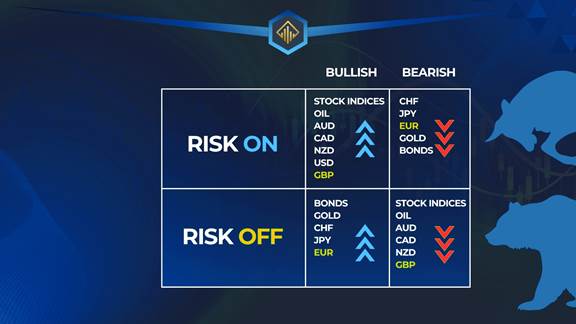
| Risk on | Risk off | |
| Tend to rise | Stock indices, oil, AUD, CAD, NZD | Government bonds, gold, JPY, CHF |
| Tend to fall | Government bonds, gold, JPY, CHF | Stock indices, oil, AUD, CAD, NZD |
| Mixed | USD, GBP, EUR | USD, GBP, EUR |
In risk-off conditions, stocks fall as investors turn defensive, oil drops as demand for energy weakens, and the commodity currencies suffer as demand for raw materials falls. In risk-on conditions, the safe havens tend to lag, because investors want returns rather than safety. Gold, for example, pays no dividend or interest.
When the rules break
Again, none of this is fixed. There have been periods, including in 2024 and 2025, when stock markets and gold have both hit record highs at the same time, which the classic model wouldn’t predict. Always check the current state of play rather than assuming the textbook relationships hold.
Using risk on/off as a prop trader
On a prop firm account, correlated positions can stack up your risk without you realising. If you’re long AUD/JPY, long the S&P 500 and short gold, you’re really making one risk-on bet three times. Know your overall exposure, and keep it within your combined risk limit.
Frequently asked questions
What does risk on mean? Investors are confident and willing to take more risk, so stocks, commodities and commodity currencies tend to rise.
What does risk off mean? Investors are worried and move money into safer assets such as government bonds, gold, the yen and the Swiss franc.
Which currencies are safe havens? Traditionally the Japanese yen and Swiss franc, and often the US dollar in times of crisis.
Is gold always risk off? Traditionally it’s a safe haven, but it can rise alongside stocks, as it did at times in 2024 and 2025.
Why does risk sentiment matter for forex? It drives correlations between currencies and other markets, helping you focus on the right pairs and avoid doubling up on the same trade.
Watch the lesson
This article goes with lesson 31 of the Prop Trader Central Masterclass, Risk on vs Risk off. https://youtu.be/YQEzgFDKXXs
Trading forex and CFDs involves a high level of risk and may not be suitable for everyone. Most retail accounts lose money when trading CFDs. This article is for educational purposes only and is not financial advice.