
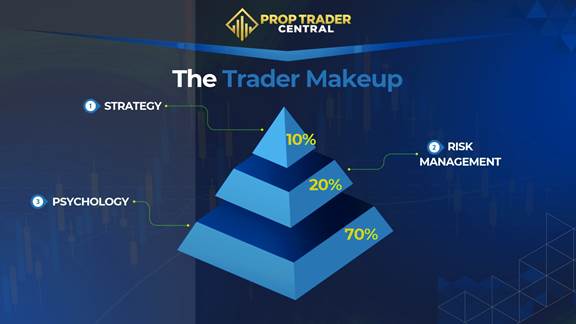
If you’ve followed me for a while, you’ll know how much weight I put on psychology. I’d say it’s around 70% of what makes a successful trader. Strategy is maybe 10%. Yet most traders spend nearly all their time on strategy. That’s why so much of the Prop Trader Central Masterclass is dedicated to psychology. In this article I’ll look at why most traders fail, and the excuses traders tell themselves that keep them stuck.
Why most traders fail
You’ll often hear that 90% or 95% of retail traders lose money. I don’t know if that’s true. What I do know is that UK brokers must publish the share of their retail accounts that lose money, and it’s typically around 70% to 80%. Whatever the exact figure, most traders lose, so we have to do things differently. That starts with understanding what they’re doing wrong.
1. They’re thrill-seekers, not traders
Humans love to gamble. It’s why betting companies advertise all around weekend sport. The thought of fast money is exciting. Lots of people come to trading with the same attitude: they deposit $500 or $1,000, or buy a few prop firm challenges, lose, and give up. That’s fine if it’s just fun. I don’t mind $10 on a horse myself. But it isn’t trading.
2. They think it’s an easy life
When new traders come to me for mentoring, I always ask why they’re doing it. Some have lost their job and can’t pay the bills. Some have just left school and don’t want university or a full-time job. They think trading is the easy way out.
It surprises me, after 35-plus years in this business. If you wanted to be a lawyer, an accountant, a surveyor, a bricklayer or a plasterer, you’d expect years of study or an apprenticeship. Why do people think they can read a book, watch a YouTube video and start making money from trading? Trading is like any other career. It takes work, dedication and focus. It’s not a get-rich-quick scheme, and it’s not a free cash machine.
3. They have unrealistic expectations
I often say that 3% to 5% a month is a huge return. Achievable, but huge. Before prop firms, many traders came in with $1,000 or $5,000 and expected 10%, 20% or 30% a month to live on. In my experience, that doesn’t happen consistently.
5% on $5,000 is $250 a month, hardly enough to pay the internet bill. So they take more risk, and blow up. And if they’re sitting in the spare room eight hours a day for that, their partner will soon tell them to get a proper job.
Now compare that with a funded account:
| Account | 2% a month | 3% a month | 5% a month |
| $100,000 | $2,000 | $3,000 | $5,000 |
| $200,000 | $4,000 | $6,000 | $10,000 |
Even 2% or 3% a month on a funded account is a worthwhile income, without taking extreme risk. And 5% a month compounded over a year is around 80%. Not many hedge funds make that.
4. The cycle of doom
I’ve covered this in its own lesson, but it’s one of the biggest reasons traders fail: a few losses, tweak the strategy, a few wins, more losses, tweak again, new strategy, round and round. Be honest with yourself. Have you been in the cycle of doom? Most of us have.
The mindset excuses
Many traders won’t accept that the problem is them. They look for something external to blame. Here are the excuses I hear most often.
“Trading is a scam”
“Nobody makes money except the platforms and the educators.” Not true. Trading has been around for centuries. Japanese rice traders were using candlestick charts over 250 years ago. There are traders who make a steady income from the markets by staying level-headed, controlling risk and keeping realistic expectations.
Of course there are scammers out there. The YouTubers with the watches, the cars and the flashy lifestyles are usually selling you something, and the lifestyle is rarely real. But trading itself isn’t a scam if you find the right place to learn and put in the work.
“The strategy was to blame”
This goes back to the cycle of doom. Remember the pyramid: strategy is maybe 10%, psychology is 70%. I guarantee that if I gave a group of traders a perfectly fair coin, buy on heads, sell on tails, a good number would still blow their accounts. It’s rarely the strategy. Usually, it’s you.
“The markets are out to get me”
“Every time I buy, it goes down. Every time I sell, it goes up.” The market doesn’t care about you. It doesn’t even know who you are. It’s been here for centuries and will be here for centuries more. Our job is to use it as a place to earn an income, with a controlled, disciplined approach.
“The broker is hunting my stops”
I have friends and colleagues in the business, and in my experience well-regulated brokers and prop firms aren’t hunting retail traders’ stops. I’m not talking about offshore outfits offering 1,000:1 leverage; choose regulated firms. Your stops matter a lot to you, but they’re a tiny dot in the market’s liquidity.
“I’ll just reverse my trades”
Some traders figure that because they always lose, they’ll copy their trades in reverse onto a live account. Someone once told me they planned to swap their candle colours and turn the screen upside down. It doesn’t work. Losing has nothing to do with the colour of the candles, and everything to do with your psychology.
“I don’t have the brains to be a trader”
You don’t need to be a rocket scientist. I’m living proof. When I stood in the pits, if Goldman Sachs, Merrill Lynch or JP Morgan were shouting “buy”, I was buying too. I’ve seen people come off the tools after years in manual trades and become very successful traders. What you need is discipline, the right approach and good education. Anyone can be a trader.
Psychology on a prop firm account
Prop firm rules expose psychology fast. Chasing a target, revenge trading after a loss, or doubling up to recover are behaviours that break daily loss limits. Recognising these traps in yourself is the first step to staying inside the rules.
In the next lesson we take a deeper dive into the emotions behind trading mistakes. Don’t underestimate psychology. It will make you, or it will break you.
Frequently asked questions
What is trading psychology? The mindset, emotions and habits that affect your trading decisions, often more than your strategy does.
Why do most traders lose money? In my experience: treating it like gambling, expecting easy money, setting unrealistic targets, and jumping from strategy to strategy.
Is trading a scam? No, although there are plenty of scammers in the industry. Trading done properly, with realistic expectations and risk control, is a legitimate career.
Do brokers hunt stop losses? In my experience, regulated brokers and prop firms don’t. Stick to well-regulated firms.
Do you need to be clever to be a trader? No. Discipline, education and the right mindset matter far more than academic ability.
Watch the lesson
This article goes with lesson 33 of the Prop Trader Central Masterclass, Psychology: https://youtu.be/mnOx0d5Zkzg
Trading forex and CFDs involves a high level of risk and may not be suitable for everyone. Most retail accounts lose money when trading CFDs. This article is for educational purposes only and is not financial advice.