
Forex pairs are the building blocks of every currency trade: each one is two currencies quoted against each other. In this guide I’ll explain the eight currencies most retail traders focus on, how pairs are grouped into majors, minors and exotics, how to read a quote, and which pairs I’d start with.
The eight major currencies
As retail traders, most of us focus on the currencies of eight of the world’s biggest economies. Cross every one of them against every other and you get 28 currency pairs, which is where most retail trading happens. Brokers offer plenty more, such as the Thai baht, Singapore dollar and South African rand, but these eight are the heart of the market.
You’ll hear traders use their nicknames all the time, so it helps to know them.
| Currency | Code | Nickname | Where the name comes from |
| US dollar | USD | The greenback | The first US government banknotes, issued in 1861, were printed with green ink on the back |
| Euro | EUR | The single currency | Launched in 1999 to replace the national currencies of the eurozone |
| Japanese yen | JPY | The yen | Usually just called the yen |
| British pound | GBP | Sterling, or cable (GBP/USD) | From 1866, pound-dollar rates were sent between London and New York by telegraph cable across the Atlantic seabed |
| Canadian dollar | CAD | The loonie | Canada’s one-dollar coin, introduced in 1987, shows a loon, a water bird |
| Swiss franc | CHF | The swissie | Short for Swiss franc |
| New Zealand dollar | NZD | The kiwi | The kiwi bird is New Zealand’s national symbol |
| Australian dollar | AUD | The aussie | Short for Australian dollar |
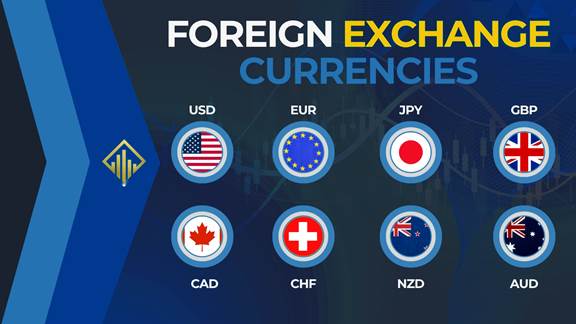
One of those eight stands well above the rest. The US dollar is on one side of 89% of all forex trades (BIS, 2025), which is why the pairs against it get a group of their own.
Majors, minors and exotics
Those 28 pairs fall into groups, and the group a pair sits in tells you a lot about how much it costs to trade.
| Group | What’s in it | Examples | Liquidity | Typical spread |
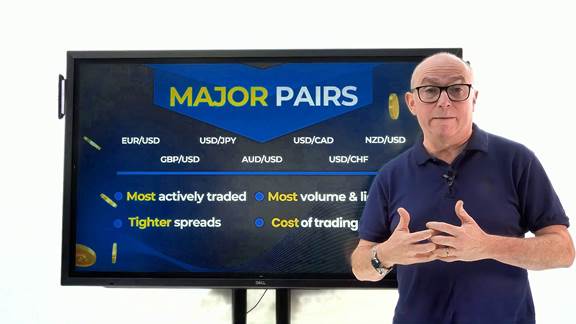
| Majors | The seven other currencies against the US dollar | EUR/USD, GBP/USD, USD/JPY, AUD/USD | Highest | Tightest |
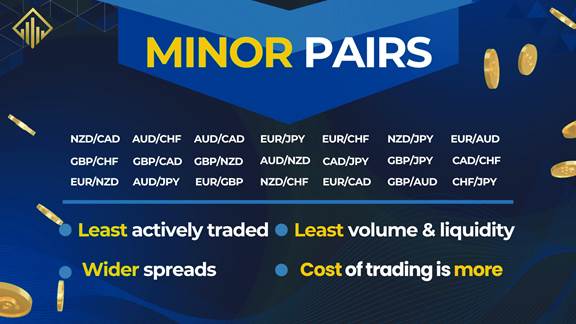
| Minors (crosses) | The other 21 pairs, with no US dollar | EUR/GBP, AUD/NZD, CAD/JPY, GBP/AUD | Lower | Wider |
| Exotics | A major currency against a smaller or emerging-market one | USD/THB, USD/SGD, USD/ZAR | Lowest | Widest |
The majors are the most actively traded pairs on the planet. With the most volume and liquidity there’s almost always a buyer or seller on the other side of your trade, and that keeps spreads tight. The spread is a cost of doing business, so if you trade the lower time frames and place several trades a day, tight spreads matter a lot.
The minors are the opposite: less traded, less liquid, and usually wider spreads, so each trade costs you more.
There’s a trap here that catches a lot of new traders. Around big news releases, and at the daily rollover when the trading day ends, liquidity thins out and spreads can widen sharply. On the minors and exotics they can widen enough to hit your stop loss for no reason other than the spread itself. It’s one of the most frustrating ways to lose a trade, so be careful holding tight stops on these pairs at those moments.
How to read a forex quote
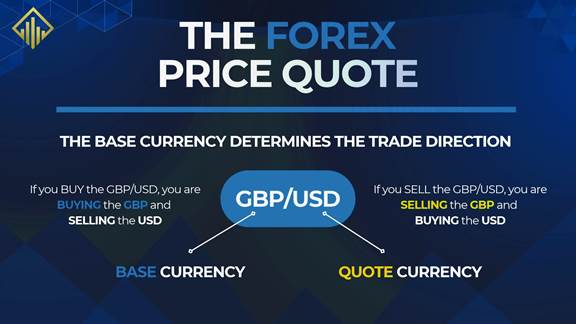
Every quote has two currencies. Take GBP/USD:
- GBP is the base currency. It’s always the first one.
- USD is the quote currency. It’s always the second.
The base currency sets the direction of your trade. When you buy GBP/USD, you’re buying pounds and selling dollars, because you expect the pound to rise against the dollar. Perhaps you think the UK economy is doing better than the US. When you sell GBP/USD, you’re selling pounds and buying dollars. Whatever you do to one currency, you’re doing the opposite to the other.
The price tells you how much of the quote currency one unit of the base currency costs. A GBP/USD price of 1.3000 means you need $1.30 to buy £1. If the price rises to 1.3100, the pound has strengthened; if it falls to 1.2900, it has weakened.
How much you make or lose on each move comes down to lots and pips, which I cover in the next lesson.
Which pairs should you trade?
It’s one of the questions I’m asked most by new traders, and my answer is nearly always the same: you don’t need to watch all 28. Be a master of a few. I’d build a watchlist of eight to ten pairs along these lines:
- A few majors, such as EUR/USD, GBP/USD and USD/JPY, for their liquidity and tight spreads.
- A couple of European currencies against a commodity currency, such as EUR/CAD, EUR/AUD, GBP/NZD or GBP/AUD.
- A yen cross or two, such as EUR/JPY or GBP/JPY.
If you can’t find opportunities in eight to ten pairs, more pairs won’t fix it. Something else in your trading needs work, and that’s especially true when you’re starting out.
Keep correlation in mind as you build that list. Currencies move together: when something big happens to the US dollar, it tends to move many other pairs in similar or opposite ways. Three trades on three dollar pairs can be one big bet on the dollar. I cover correlation in detail later in the masterclass.
Forex pairs and prop firm trading
Pair choice matters even more on a prop firm account. Most firms set a daily loss limit and a maximum drawdown, and a stop hit by a widening spread counts against you just like any other loss. Sticking mainly to the majors keeps your trading costs down and makes those surprises less likely.
Correlation matters too. Several open trades that all depend on the US dollar can take a big bite out of your daily loss limit in one move. Check each firm’s rules before you trade: some restrict which pairs you can trade, or when you can trade them around news. Comparing those rules is exactly what we help with at Prop Trader Central.
Frequently asked questions
What is a forex pair? Two currencies quoted against each other, such as EUR/USD. Every forex trade buys one currency and sells the other.
What are the major forex pairs? The seven pairs that trade the US dollar against the euro, yen, pound, Canadian dollar, Swiss franc, New Zealand dollar and Australian dollar.
What’s the difference between the base and quote currency? The base currency comes first and sets your trade direction. The quote currency comes second, and the price tells you how much of it buys one unit of the base currency.
Why is GBP/USD called cable? Because from 1866 the pound-dollar rate was sent between London and New York by telegraph cable across the Atlantic.
How many pairs should a beginner trade? I’d suggest eight to ten: a few majors, a couple of European currencies against commodity currencies, and a yen cross.
Watch the lesson
This article goes with lesson 3 of the Prop Trader Central Masterclass, Understanding Forex Pairs. Watch here https://youtu.be/wBk7IH0JZFM
Trading forex and CFDs involves a high level of risk and may not be suitable for everyone. Most retail accounts lose money when trading CFDs. This article is for educational purposes only and is not financial advice.