
A strategy is simply a set of rules that tells you when to buy and when to sell. But having one isn’t enough. You need to be confident in it, and that means knowing exactly how it performs. The better you understand your strategy, the less likely you are to fall into the cycle of doom. In this article I’ll walk through the metrics I use to evaluate a strategy, and the ones I think matter most.
The key strategy metrics
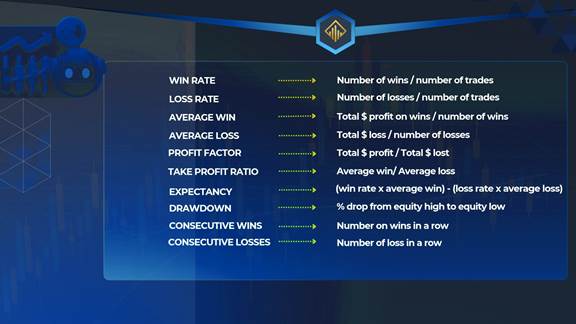
Win rate and loss rate
- Win rate = number of winning trades ÷ total trades
- Loss rate = number of losing trades ÷ total trades
You’ll often see strategies advertised with an 80% win rate. That doesn’t make them profitable on its own. If the losses are much bigger than the wins, a high win rate can still lose money. But you do need to know roughly how many wins to expect compared to losses.
Average win and average loss
- Average win = total profit on winning trades ÷ number of wins
- Average loss = total lost on losing trades ÷ number of losses
Ideally your average win is bigger than your average loss.
Profit factor
Profit factor = total profit ÷ total loss
It’s one of the most popular metrics, and you’ll see it quoted whenever a strategy is advertised. Anything above 1 makes money. Personally, I like to see a profit factor of at least 1.5 before I’ll consider a strategy.
Take-profit ratio
Take-profit ratio = average win ÷ average loss
This tells you, on average, how much bigger your winners are than your losers.
Expectancy
Expectancy is what you can expect to make, on average, per trade, allowing for the fact that you won’t win every trade:
\text{Expectancy} = (\text{Win rate} \times \text{Average win}) – (\text{Loss rate} \times \text{Average loss})
Don’t get too bogged down in the formula. What matters is that your expectancy is positive, and that it stays fairly consistent over time.
Drawdown
Drawdown is the percentage fall from a peak in your account to a later low. This may be the most important metric of all.
Say you grow a $1,000 account to $1,500, then it falls back to $1,000. You’re back to break-even, but the strategy dropped 33% from its peak. That’s how much pain it can put you through.
On a prop firm account this is critical, because you’ll have daily and overall drawdown limits. There’s no point having a strategy that makes 50% if it can also lose 100%. Always check drawdown, on your own strategy and on any strategy you’re thinking of buying.
Consecutive wins and consecutive losses
I love this one. A strategy may have an edge, but its wins and losses still arrive in random order. Knowing the longest winning and losing streaks from your backtest is one of the best defences against the cycle of doom.
If your backtest shows the strategy sometimes loses five or six in a row, then when it happens in live trading, you won’t panic. It’s already part of the edge you know the strategy has.
A worked example
Say a backtest of 100 trades gives you 45 winners averaging $300, and 55 losers averaging $150.
| Metric | Calculation | Result |
| Win rate | 45 ÷ 100 | 45% |
| Profit factor | $13,500 ÷ $8,250 | 1.64 |
| Take-profit ratio | $300 ÷ $150 | 2.0 |
| Expectancy | (0.45 × $300) − (0.55 × $150) | $52.50 per trade |
Less than half the trades win, but the strategy is clearly profitable, because the winners are twice the size of the losers.
The metrics I focus on most
If you only track a few, make them:
- Expectancy: is the strategy profitable per trade, and is that stable?
- Drawdown: how far can it fall, and can you (and your prop firm’s rules) live with that?
- Consecutive wins and losses: what streaks should you expect?
Put these into your trading journal and keep them updated. Trading is about the long term: understanding your strategy over a large number of trades and letting the probabilities play out.
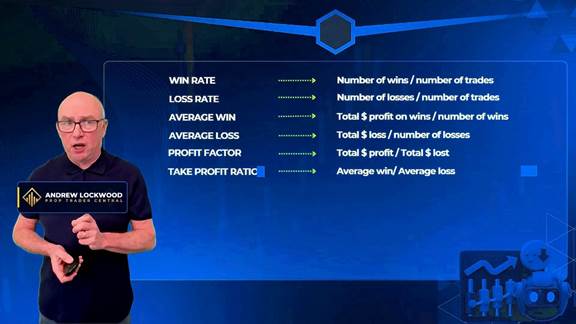
Frequently asked questions
What is a good profit factor? Anything above 1 is profitable. I like to see at least 1.5.
How do you calculate expectancy in trading? Multiply your win rate by your average win, then subtract your loss rate multiplied by your average loss.
What is drawdown? The percentage drop from a peak in your account balance to a later low.
Is a high win rate enough? No. A strategy with a high win rate can still lose money if its losing trades are much bigger than its winners.
Why track consecutive losses? So you know what losing streaks are normal for your strategy, and don’t abandon it when one happens.
Watch the lesson
This article goes with lesson 30 of the Prop Trader Central Masterclass, Knowing your Strategy. https://youtu.be/QRd2aSJPz_g
Trading forex and CFDs involves a high level of risk and may not be suitable for everyone. Most retail accounts lose money when trading CFDs. This article is for educational purposes only and is not financial advice.