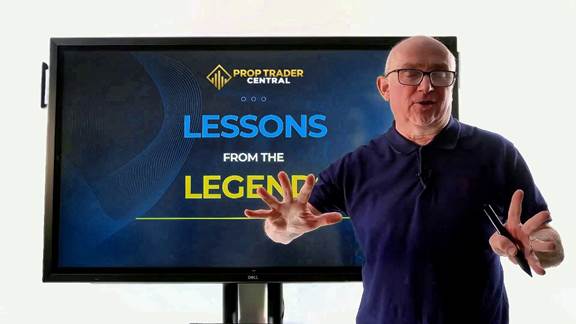
This is one of my favourite talks to give. We all know the biggest challenge in trading is psychology, and some of the greatest traders and investors who ever lived have summed it up better than any course could. If you take on board just half of what these legends say, it will serve you better than most psychology courses you could buy. Here are the lessons I’ve learned from them, and what they mean for your trading.
Trade less, and wait for the best setups
Martin Schwartz, one of Wall Street’s most successful traders, made the point that working longer doesn’t mean working smarter, and sometimes it’s the opposite. We’re brought up to believe that more hours mean more money. Trading doesn’t work like that. You don’t need to be at your desk eight hours a day. Pick the high-probability setups and step away.
Jesse Livermore, the legendary speculator of the 1920s, is credited with saying there’s a time to go long, a time to go short, and a time to go fishing. If nothing’s happening, leave it alone. You don’t always have to be in a trade.
Bill Lipschutz, one of the most successful currency traders of all time, suggested that if most traders simply sat on their hands half the time, they’d make a lot more money.
Warren Buffett uses a baseball analogy: the market keeps pitching, but you don’t have to swing. You can wait as long as you like for the perfect pitch. Before you take a trade, ask yourself: if this were the only trade I could take this month, would I take it?
Ed Seykota, a pioneer of systematic trend following, is a good example of trading less. End-of-day trading on the higher timeframes can be one of the most effective, and least stressful, ways to trade.
Protect your capital first
You’ll notice a theme running through these legends: they’re risk managers first.
Bernard Baruch, the New York financier who advised US presidents, is said to have sold most of his shares before the 1929 crash. The lesson often credited to him: it’s not about how much you make, but how much you don’t lose.
Jack Schwager, author of the Market Wizards books, summed up what he learned from interviewing top traders: amateurs think about how much they can make; professionals think about how much they could lose. Preserve your capital, and let the profits follow in time.
Ed Seykota also put it simply: setting your stop properly is one of the most important jobs you have. Place your stop where you don’t expect to be stopped out, not at an arbitrary five pips. Position sizing lets you do that.
Be patient and avoid impulse
Jack Bogle, founder of Vanguard, said: “Time is your friend; impulse is your enemy.” Over the years I’ve seen so many traders destroyed by rash, impulsive decisions. Take your time and wait for your setup.
Master one strategy
Bruce Lee probably didn’t spend much time in the markets, but his famous line applies perfectly: he didn’t fear the man who’d practised 10,000 kicks once, but the man who’d practised one kick 10,000 times. You don’t need lots of strategies. Master one.
Discipline beats a perfect strategy
Richard Dennis, famous for the Turtle Traders experiment in the 1980s, taught his students a trend-following system. He made the point that almost anyone can write a set of rules nearly as good as his. What they can’t do is stick to them when things go badly. That’s psychology. The best traders follow their rules come what may, instead of tweaking, changing and falling into the cycle of doom.
Dennis also taught that you should trade bigger when the market is going your way and smaller when it’s against you, much like the compounding approach we teach.
Price patterns repeat because people don’t change
Jesse Livermore noticed nearly 100 years ago that price patterns repeat over and over, with slight variations, because markets are driven by people, and human nature doesn’t change. That’s still true today, and it’s why technical analysis and price action work.
Paul Tudor Jones, the billionaire hedge fund manager, has said that for him price comes first and fundamentals second. I’m with him on that. On the lower timeframes especially, the news is usually already in the price.
Leave your ego at the door
Paul Tudor Jones also warned against being a hero or having an ego: the moment you think you’re very good, you’re in trouble. I’ve seen it many times: traders boasting in chat rooms, then suddenly disappearing. Stay humble. The market will always remind you who’s boss.
George Soros famously made a fortune betting against sterling in 1992, forcing the pound out of the Exchange Rate Mechanism. I was in the trading pits that day, working for a big bank, and it turned out we were on the other side of his trades. We had a rough day! Soros has said he’s only rich because he knows when he’s wrong. Admitting when you’re wrong is half the battle.
Accept the risk: lessons from Mark Douglas
The late, great Mark Douglas has been like a silent mentor to me. I’ve read his book Trading in the Zone many times, on Kindle, on paper and on audio.
His biggest lesson is to truly accept the risk. That doesn’t mean “I don’t mind losing 1%”. It means expecting to lose the money the moment you place the trade. If you’re stopped out, don’t beat yourself up. You accepted the risk, or you wouldn’t have taken the trade.
Douglas set out principles for trading consistently. In my own words:
- Define your risk before every trade. Know exactly how much you’re putting on the line.
- Completely accept that risk, and be willing to let the trade go.
- Act on your edge without hesitation. If your setup is there and every box is ticked, take it, even if the chat room says otherwise. Avoid paralysis by analysis.
- Pay yourself as the market makes money available. Take payouts from your funded account, or withdraw profits from your own. It feels good and keeps you motivated.
- Keep monitoring yourself for mistakes. That’s what a trade journal is for.
Douglas also identified four fears behind most trading errors: the fear of being wrong, of losing money, of missing out, and of leaving money on the table. Ask yourself honestly which of these affect you.
Take your losses early
Jesse Livermore warned that it’s refusing to take a loss that does the real damage, to your account and your mind. The first cut is the cheapest. Keep moving your stop, and when you’re finally stopped out, the loss will be bigger and you’ll feel rotten going into your next trade.
Cut your losses and let your winners run. We’ve all heard it. It’s simple to say and hard to do.
Know your exit before you enter
Bruce Kovner, another billionaire hedge fund trader featured in Market Wizards, said he always knows where he’s getting out before he gets in. You wouldn’t walk into a building without knowing where the exit is. Decide the point at which your trade idea is proven wrong, and put your stop there.
The market is always right
I’ve heard traders say “I can’t believe the market got that wrong.” The market is never wrong. It doesn’t care about you or me. Trade what the market is actually telling you on the chart, not what you think it should be doing.
There’s a famous line, usually credited to the economist John Maynard Keynes: “Markets can remain irrational longer than you can remain solvent.” People call a market overbought or overvalued, and it keeps going. Don’t fight it.
Don’t expect a steady paycheque
Trading income isn’t a monthly salary. Some months will be flat or down. Make sure you have the capital and the buffer to get through those periods. If you expect to make money every day or every month, you’ll force bad trades.
Compounding
The line usually attributed to Albert Einstein (though there’s no evidence he said it) is that compound interest is the eighth wonder of the world. Used properly, risking a percentage of your current balance, it works for you in winning runs and protects you in losing ones.
And finally, one of mine
I’m a trend follower, and I’ve always said: the trend is your friend, until the bend at the end. Ride the trend, but expect it to turn at some point.
Put them on your desk
The themes are clear: cut your losses, let your winners run, don’t feel you always need to be in a trade, accept the risk and follow your rules. Pick your favourite lessons, write them down, stick them by your screen, and read them every day before you start trading.
Frequently asked questions
What is the most important lesson from great traders? Almost all of them put managing risk and protecting capital ahead of chasing profits.
What does “accept the risk” mean? Expecting to lose the money you’ve risked the moment you place a trade, so a loss doesn’t knock you off balance.
Which trading books do you recommend? Trading in the Zone by Mark Douglas and the Market Wizards series by Jack Schwager are both excellent on trading psychology.
Should I trade every day? No. As many of these legends say, waiting for the best setups and trading less often leads to better results.
Watch the lesson
This article goes with lesson 35 of the Prop Trader Central Masterclass, Lessons from the Legends. https://youtu.be/CcQh5oenR-A
Trading forex and CFDs involves a high level of risk and may not be suitable for everyone. Most retail accounts lose money when trading CFDs. This article is for educational purposes only and is not financial advice.