
Nov 2026 by Andrew Lockwood
Lots tell you how much you’re trading; pips tell you how far the price has moved. Put the two together and you know exactly what each trade can make or lose. In this guide I’ll explain both, show you how to work out what a pip is worth, and how I use them to size every trade.
What is a lot?
A lot is the forex word for trade size. When you buy shares, you might buy 10 shares in Tesla or 100 in Amazon. In forex you trade in lots instead, and a lot is always measured in the base currency, the first currency in the pair.
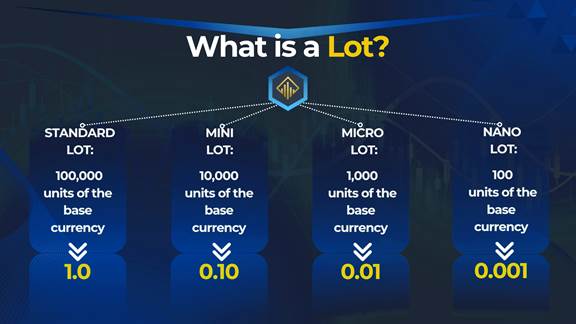
One standard lot is 100,000 units of the base currency. On GBP/USD that’s £100,000; on AUD/USD it’s A$100,000. You don’t have to trade whole lots: you can trade multiples, such as 1.5 lots (150,000 units), or fractions, such as 0.3 lots (30,000 units).
| Lot | Units of base currency | Order ticket shows |
| Standard | 100,000 | 1.00 |
| Mini | 10,000 | 0.10 |
| Micro | 1,000 | 0.01 |
| Nano | 100 | 0.001 |
Most platforms now go down to 0.01, a micro lot. A few brokers still offer nano lots, but honestly, if you want to trade that small, you’re better off on a demo account. When you’re starting out, I’d begin with very small sizes while you get to know the platform.
Here’s what a standard lot means in practice. If GBP/USD is trading at 1.2560 and you buy one lot, you’re exchanging $125,600 for £100,000. Change the volume on the order ticket to 0.50 and it’s £50,000; change it to 0.15 and it’s £15,000. Whatever the platform, MT5, DXtrade or another, the lot size always refers to the base currency.
What is a pip?
A pip is the smallest standard move in a currency pair’s price. On most pairs it’s the fourth decimal place, 0.0001. Yen pairs are the exception: there it’s the second decimal place, 0.01. You’ll see pip described as “percentage in point” or “price interest point”. What the letters stand for matters far less than what a pip means for your trading.
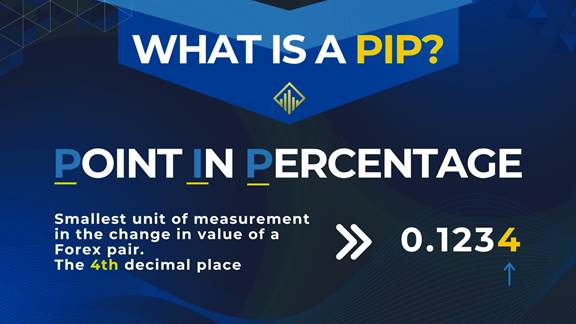
Take EUR/USD at 1.0947:
| Move | New price |
| Up 2 pips | 1.0949 |
| Down 2 pips | 1.0945 |
| Up 15 pips | 1.0962 |
| Down 15 pips | 1.0932 |
When traders talk about how many pips they made or lost, this is what they mean.
Most brokers now quote a fifth decimal place too, for example 1.09476. That extra digit is a pipette, a tenth of a pip. Unless you’re scalping very short moves, you can mostly ignore it and think in pips.
How much is a pip worth?
This is the part that really matters. The maths is simple: one standard lot is 100,000 units, and one pip is 0.0001.
100{,}000 \times 0.0001 = 10 \text{ units of the quote currency}
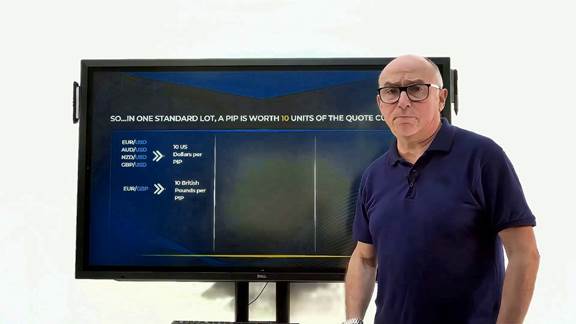
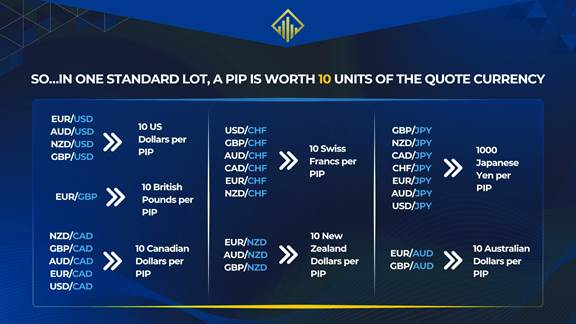
So on one standard lot, a pip is worth 10 units of the quote currency, the second currency in the pair.
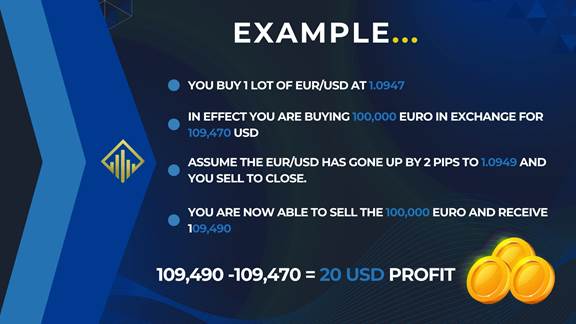
Here’s a worked example. You buy one lot of EUR/USD at 1.0947, which means buying €100,000 for $109,470. The price rises two pips and you sell at 1.0949, receiving $109,490. The difference is $20: two pips at $10 each.
| Quote currency | Pip value: 1 standard lot | 1 mini lot | 1 micro lot |
| US dollar (e.g. EUR/USD) | $10 | $1 | $0.10 |
| British pound (e.g. EUR/GBP) | £10 | £1 | £0.10 |
| Canadian dollar (e.g. USD/CAD) | C$10 | C$1 | C$0.10 |
| Swiss franc (e.g. USD/CHF) | CHF 10 | CHF 1 | CHF 0.10 |
| Japanese yen (e.g. USD/JPY) | ¥1,000 | ¥100 | ¥10 |
Yen pairs look different because a yen pip is 0.01, not 0.0001: 100,000 × 0.01 = ¥1,000.
Converting to your account currency
Most trading accounts are held in US dollars, so a pip worth C$10 or ¥1,000 has to be converted. Divide by the current exchange rate. If USD/CAD is at 1.40, C$10 is about $7.14 a pip. If USD/JPY is at 150, ¥1,000 is about $6.67. Pairs quoted in dollars, like EUR/USD and GBP/USD, need no conversion: $10 a pip.
Your platform and any online pip value calculator will do this for you. But understand how it’s worked out, so you always know what a move is costing you.
Putting it together: profit, loss and trade size
Once you know the pip value, every trade’s outcome is just pips multiplied by pip value multiplied by lots.
On GBP/USD, one standard lot is $10 a pip. Set a 40-pip profit target and a 25-pip stop loss, and you’re aiming for $400 with $250 at risk. Halve the size to 0.5 lots and it’s $200 against $125. The pips don’t change; the lot size decides the money.
The better way to use this is backwards. Decide how much you’re prepared to lose first, then let the lot size follow:
Say you have a $10,000 account and risk half a percent per trade, which is $50. Your stop loss on EUR/USD is 25 pips, and a pip is $10 per standard lot:
If the trade hits your stop, you lose $50, exactly what you planned. Widen the stop to 50 pips and the size drops to 0.1 lots, so the risk stays at $50. That’s the habit I want every new trader to build: the stop goes where the chart says, and the lot size adjusts to keep the risk fixed.
Lots, pips and prop firm rules
On a prop firm account, lots and pips are how you stay inside the rules. Every firm sets a daily loss limit and a maximum drawdown, and both are measured in money, not pips. If your lot size is too big for your stop loss, one bad trade can breach the daily limit and end the account.
So before every trade, work backwards from the firm’s limits. Say the daily loss limit is 5% of a $100,000 account, so $5,000. I suggest risking no more than half a percent, or $500, on any trade. Then you’d need ten losers in a row in one day to hit it. With the sizing method above, that’s easy to stick to: decide your risk, measure your stop in pips, and let the lot size follow.
Frequently asked questions
What is a lot in forex? A unit of trade size. One standard lot is 100,000 units of the base currency, a mini lot 10,000 and a micro lot 1,000.
What is a pip in forex? The smallest standard price move: 0.0001 on most pairs and 0.01 on yen pairs.
How much is one pip worth? On one standard lot, 10 units of the quote currency: $10 on EUR/USD or GBP/USD. On a micro lot it’s $0.10.
What is a pipette? The fifth decimal place in a quote, worth a tenth of a pip.
What lot size should a beginner use? Start small, with micro lots, and size every trade from your risk and stop loss rather than picking a number.
Watch the lesson
This article goes with lesson 4 of the Prop Trader Central Masterclass, Lots and Pips. https://youtu.be/v2o1yAPFOFA
Trading forex and CFDs involves a high level of risk and may not be suitable for everyone. Most retail accounts lose money when trading CFDs. This article is for educational purposes only and is not financial advice.