
A stop loss is an order that closes a losing trade at a price you choose in advance, so one bad trade can never do more damage than you planned. If I could teach new traders only one habit, it would be this one. In this guide I’ll explain how a stop loss works, the rules I follow, and how a trailing stop can help you stay in winning trades for longer.
What is a stop loss?
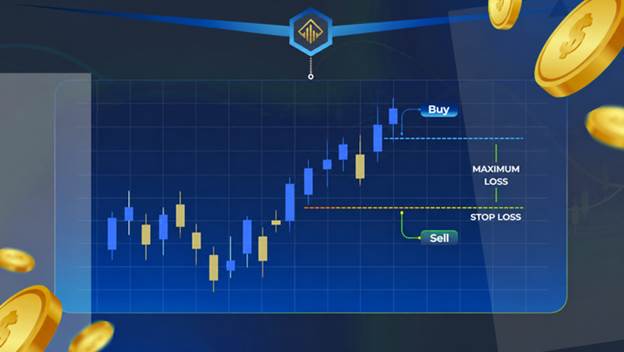
A stop loss is a pending order attached to an open trade. If the market moves against you and reaches your stop price, the trade is closed automatically and your loss is capped.
- On a buy (long) trade, the stop sits below your entry. If the price falls to it, your position is sold.
- On a sell (short) trade, the stop sits above your entry. If the price rises to it, your position is bought back.
You’ll hear some people say you should never use a stop loss. I think that’s absolutely ludicrous. Whether you’re a beginner or have traded for years, trading without a stop means that one day a single trade can blow up your account, and possibly more.
My stop loss rules
1. Never move your stop to avoid a loss
This is the big one. A trader puts a stop in, the market starts moving towards it, the loss starts to feel real, and they move the stop further away. Sometimes the market turns and they get away with it. But the habit grows: move it, move it again, and one day the market doesn’t turn. I can’t tell you how many accounts I’ve seen blown up by traders who wouldn’t book a loss. The first cut is the cheapest.
2. Place the stop at the same time as the trade
A stop loss always belongs to an open position. Place it with your entry, as part of the same order ticket, not afterwards. On most platforms you set the stop on the ticket and it goes in the moment the trade fills.
3. Use the stop to define your risk
Your stop is what lets you decide, before you enter, exactly how much a trade can cost you. I don’t see why you’d risk more than about half a percent of your account on any one trade. Some educators talk about 2%, which I think is bonkers: a short run of losers and you’ve blown the account or hit your drawdown limit.
Knowing the distance to your stop in pips also lets you work out the right position size, so the money at risk stays the same whatever the stop distance. I cover position sizing in its own lesson.
4. Let the platform tidy up
When the trade closes, whether at your profit target or by you closing it, the platform removes the stop automatically. There’s nothing left to do.
Stop losses and emotions
People often tell traders to trade without emotion. I think that’s nearly impossible: trading is an emotional business. What you can do is take away anything that makes the emotions worse, and a stop loss is the best tool I know for that.
Not knowing how much a trade could cost you, or whether it could knock you out of your account, is what really drives fear and bad decisions. Once you’ve truly accepted that every strategy has winners and losers, and you’ve fixed your risk at something like a quarter or half a percent, a stop being hit stops being a drama. It’s just part of the game, and you move on to the next trade.
Trailing stops: using your stop to stay in winners
A stop loss doesn’t only protect you. A trailing stop sits a set distance from the price and follows it as the trade moves into profit, but never moves back. It’s designed to keep you in a trend for longer and catch the occasional home run.
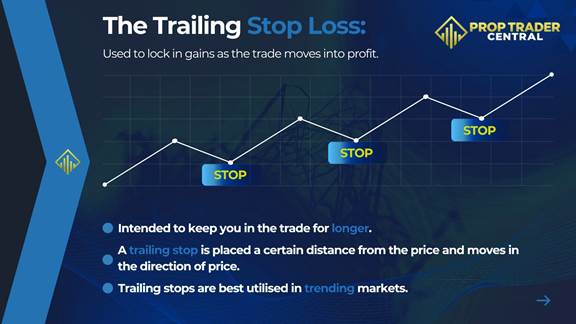
Here’s how it played out in a back-test in the lesson. I sold EUR/USD with a 50-pip trailing stop:
- The stop starts 50 pips above the entry.
- As the price falls, the stop follows it down. Within the first candle it’s almost at break-even.
- The market keeps making new lows, and the stop moves into profit with each one.
- Eventually a pullback reaches the stop, and the trade closes about 150 pips in profit.
| Trailing stop: pros | Trailing stop: cons |
| Keeps you in strong trends for longer | You always give some profit back at the end |
| Locks in profit as the trade moves | Gets whipsawed out in sideways, choppy markets |
| Takes the decision out of your hands | May finish below a fixed profit target if the move stalls |
Trailing stops work best in trending markets. In a consolidation the price swings back and forth and you’ll just get stopped out. A good middle ground is to take half the position off at your first profit target and trail the rest. Which approach suits your strategy is something to find out by back-testing it.
Stop losses and prop firm rules
On a funded account, the stop loss isn’t optional. Every prop firm sets a daily loss limit and a maximum drawdown, and breaking either one usually ends the account on the spot. Your stop is what makes those limits impossible to hit by accident.
Some firms go further and require a stop loss on every trade, or limit how much you can risk on a single position. Small risk per trade matters even more here: at half a percent a trade, it takes a long losing run to threaten a 5% daily limit. At 2% a trade, three losers in a morning can be enough. Check the exact rules of any firm before you trade, which is exactly what we help with at Prop Trader Central.
Frequently asked questions
What is a stop loss in trading? An order that automatically closes a losing trade at a price you set in advance, capping how much you can lose.
Where should I put my stop loss? At a level where your trade idea is proved wrong, such as just beyond support or resistance. Then size the position so that distance equals the amount you’re willing to risk.
Can a stop loss fail? It can be filled at a worse price than you set if the market gaps or moves very fast, for example around big news. That’s called slippage. It still limits the damage far better than having no stop.
What is a trailing stop? A stop that follows the price as a trade moves into profit, locking in gains while letting the trade run.
How much should I risk per trade? I suggest no more than about half a percent of your account.
Watch the lesson
This article goes with lesson 7 of the Prop Trader Central Masterclass, The Most Important Order You Will Ever Use. https://youtu.be/maK3Hj8SmWU
Trading forex and CFDs involves a high level of risk and may not be suitable for everyone. Most retail accounts lose money when trading CFDs. This article is for educational purposes only and is not financial advice.