
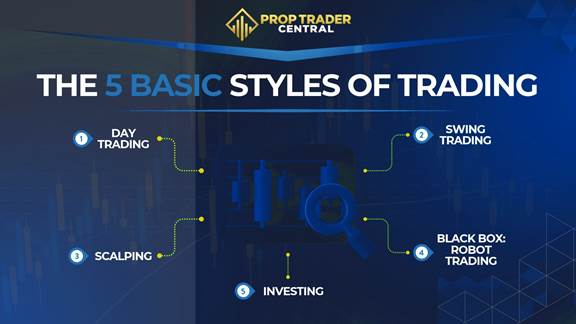
Your trading style is how often you trade and how long you hold each position, and the right one depends on your personality and the time you have. We’re all different, with different lifestyles and different reasons for trading. In this guide I’ll explain the five main trading styles, who each one suits, and why trading less is often best.
The five trading styles at a glance
| Style | Trades | Holding time | Typical charts | Screen time | Suits |
| Scalping | 20–30 a day | Seconds to minutes | 1, 5 and 15 minute | All session | Very high discipline and self-control |
| Day trading | 3–4 a day | Minutes to hours, closed by day end | 15 minute, 1 hour, 4 hour | Several hours a day | Disciplined traders who can watch the market |
| Swing trading | A few a week | Days, sometimes over weekends | 4 hour, daily, weekly | 10–30 minutes a day | People with jobs, shift workers, and anyone who finds the emotions hard |
| Automated (robots, EAs) | Varies | Varies | Varies | Monitoring | Those who understand the limits of algorithms |
| Investing | Occasional | Months to years | Weekly, monthly | Little | Long-term goals like a pension or school fees |
The time frames overlap. A scalper and a day trader may both look at the 15-minute chart, and a day trader and a swing trader may both use the four-hour.
Day trading
Day traders are in and out of the market several times a day, perhaps three or four trades a day and 15 to 20 a week, usually closing everything before the day ends. Because you’re actively watching the market, you need to be well in control of your emotions and very disciplined. Day traders typically use the 15-minute, one-hour and four-hour charts together.
Swing trading
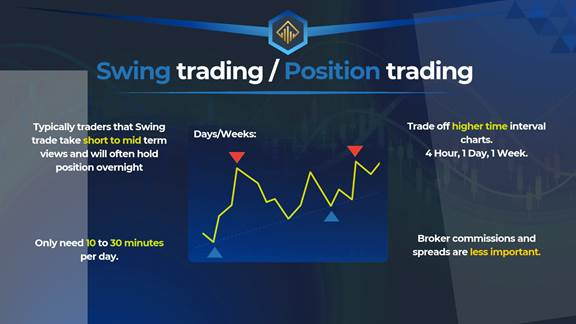
Swing traders take short- to medium-term views and hold trades for more than a day, often overnight and sometimes over the weekend. They use the higher time frames: the four-hour, daily and even weekly charts. Many of the end-of-day strategies I teach are swing strategies.
Swing trading only needs 10 to 30 minutes a day on the charts, so it suits people with a day job or shift work. It also suits anyone who finds the emotional side of trading hard. We’re led to believe that the more hours you put in, the more you should earn, but in trading that’s not true. The biggest challenge for most traders is psychology, so it stands to reason that trading less exposes you to fewer emotional swings. Spreads and commissions also matter less, because you trade less often. Don’t underestimate swing trading. Often, less is best.
Scalping
Scalping is what draws many people into trading in the first place. Watching money flow in and out of the account is exciting, the same appeal that betting companies rely on with their Saturday sports adverts. People like the idea of fast, easy money, and therein lies the danger.
Scalpers look for very small profits, with very tight stops and targets, and may trade 20 or 30 times a day on the one-minute, five-minute and 15-minute charts. Back in the trading pits, scalping is exactly what we did, sometimes buying and selling within seconds. Today anyone can do it from a screen.

Scalping takes an extremely high level of discipline. I’ve seen it time and again: a scalper loses control for one day and gives back everything they made that month. Costs matter enormously too. When each profit is small, spreads and commissions eat a big share of it, especially in less liquid markets with wider spreads. If you’re drawn to scalping, ask yourself honestly why, and whether your personality suits it.
Automated trading: robots and expert advisors
Black-box robots, or expert advisors (EAs), are programs built from algorithms that scan the market and place trades for you. There’s a place for algorithmic trading, but understand its limits. I’ve yet to find one that works consistently for me. If you find one, let me know, and tell the central bank of Venezuela while you’re at it.
Be especially wary of martingale systems, which many off-the-shelf robots use. A martingale system adds to losing trades and waits for the market to turn, then gets out at break-even or a small profit. It can show a 90–95% win rate, but the few losing trades are big enough to wipe out the account. And if a robot is advertised for $99, it’s probably worth about $99.
Investing
Most of us have invested in some form: a pension, dividend shares, even property. Investing is still trading, because you buy something expecting it to rise in value, but it’s long term. The money isn’t needed for day-to-day living, and it often has a goal, such as school fees in ten years or growing a pension pot.
How to choose your trading style
Two things decide it:
- Your psychological make-up. How disciplined are you, and how well do you handle the emotional swings of winning and losing?
- The time you have. There’s no point choosing a style you can’t fit into your day.
My advice is to pick one style and stick with it rather than mixing them. And think about why you came into trading. Most people want control of their own time, not to be a slave to a boss. If that’s you, do you really want to sit in front of the screens for eight, ten or twelve hours a day?
Trading styles and prop firms
Your style affects which prop firm suits you. Some firms restrict holding trades overnight or over the weekend, which matters for swing traders. Others restrict very short-term trading or trading around news, which matters for scalpers. Many don’t allow expert advisors, or only certain kinds. Check the rules against your style before you pay for an evaluation. Matching traders to the right firm is exactly what we do at Prop Trader Central.
Frequently asked questions
What are the main trading styles? Scalping, day trading, swing trading, automated trading and investing.
What is the difference between day trading and swing trading? Day traders open and close trades within the same day. Swing traders hold for days, using higher time frame charts and spending less time at the screen.
Is scalping good for beginners? Usually not. It needs very high discipline, and spreads and commissions take a large share of the small profits.
What is a martingale strategy? A system that adds to losing trades, hoping the market turns. It wins often, but the occasional loss can wipe out an account.
Which trading style is best? The one that fits your personality and the time you have. For many people with a job, swing trading is the most realistic.
Watch the lesson
This article goes with lesson 10 of the Prop Trader Central Masterclass, Trading Style. https://youtu.be/9YMIsEVZI_o
Trading forex and CFDs involves a high level of risk and may not be suitable for everyone. Most retail accounts lose money when trading CFDs. This article is for educational purposes only and is not financial advice.