
A trading strategy is a written set of rules that tells you exactly when to enter a trade, how much to risk and when to get out. Most new traders don’t have one, and in my experience that always ends in failure. But a strategy is also far less important than most people think. In this guide I’ll explain where strategy fits, what makes a good one, and exactly what to put in yours.
What makes a trader?
I think of a trader as a pyramid with three layers.
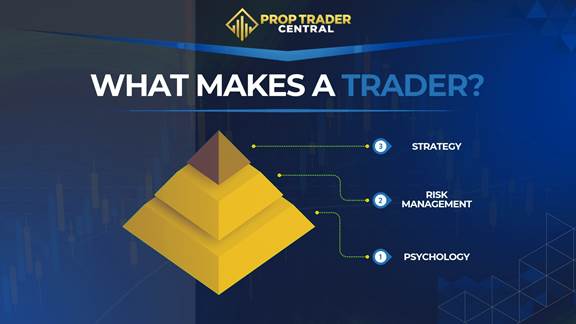
| Layer | My rough weighting | Why |
| Psychology (the base) | 70% | Without the right mindset, everything above it falls apart |
| Risk management (the middle) | 20% | You need a plan for how much you risk and when you cut losses |
| Strategy (the top) | 10% | Essential, but by far the smallest part |
Those numbers aren’t scientific, but the order is the point. Most new traders, and plenty of experienced ones, spend nearly all their time searching for the perfect strategy, the smallest part of the job. That’s why I dedicate so much of this masterclass to psychology.
Having said that, you can’t trade without a strategy. Think of a three-legged stool: take away any one leg and it topples over.
What a trading strategy is
A trading strategy is a defined set of rules for entering and exiting trades: if A does this and B does that, I do this. Nothing is left to the imagination. You don’t have to invent your own. You can use one of ours, someone else’s, or one you’ve paid for. Spending thousands on a strategy doesn’t make it better than one you build yourself. Whichever you choose, you have to make it your own.
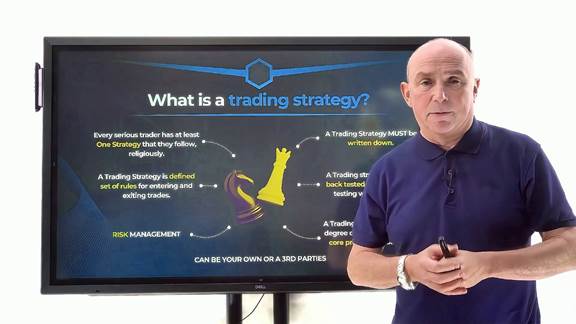
Every good strategy meets five rules:
- It’s precise enough to hand over. If you went on holiday, your partner or a friend should be able to follow your rules and keep trading for you.
- It includes your risk management. How much you risk per trade, perhaps a quarter of a percent, and how you exit, for example taking half off at the first target. These are decided in advance, never on the fly.
- It’s written down. I’ve lost count of the traders who told me their strategy was “up here” in their head. If it’s in your head, it changes with your mood.
- It’s back-tested before you trade it live. Back-testing proves it has an edge, and shows you how it behaves: its winning runs, its losing runs and the markets it struggles in.
- It allows judgement, but the core rules don’t change. We’re discretionary traders, not robots. If a strategy could just be switched on to print money, central banks would have bought it long ago.
One strategy is enough to start with, and I’d say three is the most anyone needs.
What to include in your trading strategy
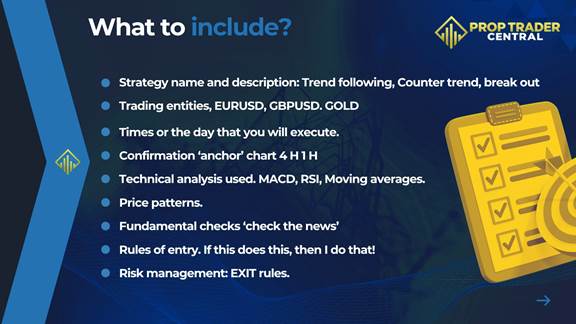
These are the sections I’d put in any written strategy. Use them as a template.
| Section | What to write |
| Name and description | Give it a name, like my Boomerang strategy, and say what type it is: trend following, breakout, reversal, five-minute scalping, news-driven |
| Markets | Exactly which instruments it trades, e.g. EUR/USD, GBP/USD, gold. Don’t jump to a new market just because it’s in a losing run |
| Trading times | When you’ll trade it: the London open, New York open, Asian session. This stops boredom trades late at night |
| Time frames | Which charts you use for direction and which for entry, so you can’t go hunting for confirmation on another time frame |
| Technical tools | Any indicators (moving averages, RSI, MACD, ATR), support and resistance |
| Price patterns | The candle patterns you act on, e.g. pin bars, engulfing patterns |
| Fundamental checks | Your news rules, e.g. no new trades 30 minutes before a high-impact release, or stepping aside before non-farm payrolls |
| Entry rules | The exact conditions that must all be true before you enter |
| Risk and exit rules | Risk per trade, stop placement, profit targets, partial exits, trailing stops |
My own approach is fairly plain. Being an ex-floor trader, I mostly use support and resistance and a couple of moving averages for trend.
Turn it into a checklist
I’m a private pilot, and no pilot takes off without running through a checklist. Trading should be the same. Turn your strategy into a checklist and tick every item before you place a trade. If everything’s ticked, you trade; if it isn’t, you don’t. It takes the stress out of decision-making and stops the fly-by-the-seat-of-your-pants trading that causes problems in the long run.
Avoid the cycle of doom
The cycle of doom goes like this. Your strategy makes money, then hits a losing run. You tweak it, it makes money again, and you think you’ve cracked it. Then it loses again, so you tweak it again, round and round, until you ditch it and start hunting for another one.
The way out is back-testing. If you know how your strategy normally performs, including how long its losing runs usually last, you can stick with it through a normal drawdown instead of tinkering. That’s not the same as sticking with a strategy that only ever loses, but you’ll know the difference because you’ve done the work.
Trading strategies and prop firms
A prop firm evaluation is the perfect place for a written strategy. Your rules have to fit inside the firm’s rules: risk per trade small enough for the daily loss limit, no trading through news if the firm restricts it, and the instruments the firm allows. Write those limits into your strategy before you start, and your checklist will keep you inside them. Every firm’s rules differ, which is why we compare them in detail at Prop Trader Central.
Frequently asked questions
What is a trading strategy? A written set of rules for when to enter a trade, how much to risk and when to exit, so nothing is left to on-the-spot decisions.
How many trading strategies should I have? At least one, and no more than about three.
Do I need to create my own strategy? No. You can use someone else’s, but you must understand it, back-test it and make it your own.
Why should a trading strategy be written down? Because a strategy that lives in your head changes with your mood. Written rules keep you consistent.
What is the most important part of trading? In my view, psychology, followed by risk management. Strategy matters, but it’s the smallest part.
Watch the lesson
This article goes with lesson 9 of the Prop Trader Central Masterclass, What is a Strategy. https://youtu.be/D2Q60Jsd8zw
Trading forex and CFDs involves a high level of risk and may not be suitable for everyone. Most retail accounts lose money when trading CFDs. This article is for educational purposes only and is not financial advice.