In this first lesson, I explain the basics behind the Forex market.
What Is Forex? A Beginner’s Guide to the World’s Biggest Market
Nov 24, 2026 · @Andrew
Forex is the global market where one currency is exchanged for another, and it’s the largest financial market in the world. You might hear it called FX, the currency market or foreign exchange. They all mean the same thing, and in this guide I’ll simply call it forex.
I started my career in a trading pit in London, and forex is where I tell every new trader to begin. In this guide I’ll walk you through what forex is, how a currency trade works, where it happens, who takes part, and why so many traders choose it. Whether you want to trade your own money or work towards a funded prop firm account, these fundamentals come first.
The largest financial market in the world
Forex trading averaged $9.6 trillion a day in April 2025, up 28% from 2022, according to the Bank for International Settlements’ latest Triennial Survey (BIS). The US dollar was on one side of 89% of those trades.
That figure includes every currency exchange: banks trading with each other, companies paying overseas suppliers, central banks managing their reserves, and the travel money you buy at the airport. The bond and stock markets trade far less each day, and crypto, while growing fast, is still a fraction of the size.
For traders, that size means one thing above all: liquidity. There is almost always someone ready to buy when you want to sell, and the other way round.
How a forex trade works
Every forex trade is two transactions at once: you buy one currency and sell another at the same time. That is why currencies are always quoted in pairs, such as GBP/USD or EUR/USD.
When you trade a pair, you are really comparing the strength of one economy against another. As a rule of thumb, a strong economy tends to have a strong currency and a weak economy a weak one. Interest rates, inflation, growth and politics all feed in, and the balance between two economies shifts constantly through the trading day. Those shifts are what traders aim to profit from.
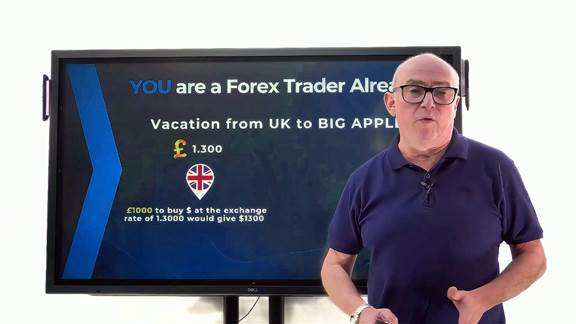
You may already be a forex trader
Chances are you’re already a forex trader. If you’ve ever changed money for a holiday abroad, you’ve made a forex transaction. Here’s the example I use with every new student.
- You live in the UK and plan a trip to New York with £1,000 spending money.
- The exchange rate is 1.30, so your £1,000 buys $1,300.
- The trip is cancelled, and a few weeks later you change the dollars back.
- The pound has weakened in the meantime and the rate is now 1.20.
- Your $1,300 now buys back about £1,083.
You are £83 better off without doing anything, simply because the exchange rate moved in your favour. That is the heart of forex trading: speculating on how one currency moves against another. Of course, if the rate had moved the other way, you would have lost money instead.
Where forex is traded
Forex has no central exchange and no trading floor. When I started out, prices were made by traders shouting across an open-outcry pit. Forex isn’t like that: it’s traded entirely electronically, around the clock.
Prices come from a network of liquidity providers, mainly banks and other financial institutions, each quoting the rates at which they will buy and sell. This network is known as an ECN, or Electronic Communications Network. As buyers and sellers adjust their prices to get orders filled, the network creates the live prices you see on screen.
Retail traders reach that liquidity through a broker. The broker sits in the middle, gives you a trading platform, holds your deposit and routes your trades into the wider market.
Who trades forex
Retail traders are only a small part of the forex market. The main participants are:
- Governments and central banks. They buy and sell their own currency to support or weaken it, manage reserves and invest abroad.
- Banks. FX desks trade currencies with each other all day, on a far bigger scale than individual traders.
- Companies. A UK firm buying machinery from China needs Chinese currency; a business buying commodities may need Australian dollars.
- Hedge funds. They trade currencies to reduce, or deliberately increase, their exposure to a particular currency across their stock and bond holdings.
- Retail traders. People trading from home on a laptop or phone through a broker. A small share of the total, but growing every year.
Why traders choose forex
Forex is the most actively traded market on the planet, and in my experience there are six good reasons for that.
- Plenty of opportunity. There are dozens of currency pairs to choose from, so something is almost always moving.
- Low trading costs. Brokers compete hard for business, so commissions are low and spreads on the major pairs are often very tight. Costs still vary by broker and account type.
- Deep liquidity. It is easy to get in and out of trades at a fair price. Compare that with some smaller crypto coins, where thin liquidity can make exits expensive.
- Easy access. All you need is a laptop or smartphone and a stable internet connection, from almost anywhere in the world.
- Leverage. Brokers let you control a larger position with a smaller deposit. Leverage magnifies losses just as much as gains, so treat it with real respect (see below).
- Trading hours. The market runs 24 hours a day, five and a half days a week. It closes at 5pm New York time on Friday and reopens on Sunday afternoon as Asia opens, so it fits around a day job, shift work or study.
A word on leverage
Regulators cap the leverage brokers can offer retail traders. In the EU, the limit is 30:1 on major currency pairs (ESMA), and the UK applies the same cap. In the US it is 50:1 on major pairs and 20:1 on others (OANDA). Some offshore brokers still advertise 500:1 or more.
My advice if you’re starting out: 10:1 or 20:1 is plenty. I’ve seen brokers offer 500:1 and even 1,000:1, and if you don’t fully understand leverage, that’s the fastest route I know to an empty account. You can make good money with low leverage.
Forex and prop firm trading
Most prop firms offer forex as their main market, which makes it the natural place to start if a funded account is your goal. A prop firm lets you trade its capital once you pass an evaluation on a simulated account. Pass, and you keep a share of the profits you make.
The catch is the rules. Every firm sets a profit target, a daily loss limit and a maximum drawdown, and breaking one usually ends the account. That’s why the basics in this guide matter so much: on a funded account, sloppy use of leverage doesn’t just cost you money, it costs you the account.
The rules, fees and profit splits vary a lot from firm to firm. That’s exactly why I set up Prop Trader Central: to help traders learn the skills first, then compare the firms and pick the one that suits the way they trade.
Frequently asked questions
What is forex in simple terms? Forex is the exchange of one currency for another. Forex traders speculate on how the value of one currency will move against another.
How big is the forex market? About $9.6 trillion is traded every day, which makes it the largest financial market in the world (BIS, April 2025).
When can I trade forex? The market is open 24 hours a day from Sunday afternoon to Friday at 5pm New York time.
Do I need a broker to trade forex? Yes. Retail traders reach the market through a broker, which provides the platform and access to liquidity.
Is leverage dangerous? It can be. Leverage increases both profits and losses, so beginners should keep it low and always use a stop loss.
Can I trade forex with a prop firm? Yes. Forex is the main market at most prop firms. You trade a simulated account to pass an evaluation, then follow the firm’s loss and drawdown rules on the funded account.
Watch the lesson
This article goes with the lesson What is Forex? In the Prop Trader Central Masterclass https://youtu.be/svGKJQUWAvk
Trading forex and CFDs involves a high level of risk and may not be suitable for everyone. Most retail accounts lose money when trading CFDs. This article is for educational purposes only and is not financial advice.