
Leverage is a loan from your broker that lets you control a much bigger position than your deposit. I think it’s the number one reason people are drawn to forex and CFDs: you get a much bigger bang for your buck. But leverage is a double-edged sword. Used wisely it’s hugely powerful; used unwisely, it’s the short, fast way to the poorhouse.
What is leverage?
If you’ve ever bought a home with a mortgage, you’ve already used leverage.
Say you buy a house for $100,000. You put down a $20,000 deposit and the bank lends you the other $80,000. That’s leverage of 5:1: every dollar of yours controls five dollars of house.
Now say you timed it perfectly and over ten years the house doubles in value to $200,000. You sell, repay the bank’s $80,000, and you’re left with $120,000. Your $20,000 has made you $100,000 profit. Without the loan, $20,000 of property doubling would have made you $20,000. That’s the power of leverage.
Compare that with buying shares. With $5,000 you could buy a handful of Apple, Meta or Amazon shares. If they rise 10% in a year, you make $500: nothing wrong with that, but not a big return on your money. Forex and CFD trading work like the mortgage: your broker lends you the rest, so a small deposit controls a much larger position.
How leverage works in forex
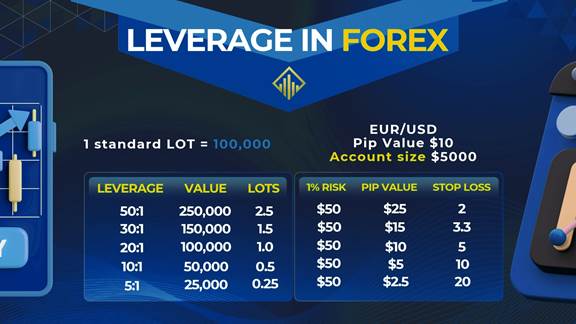
Remember that one standard lot is 100,000 units of the base currency, and on EUR/USD each pip is worth $10 per lot. Here’s what different levels of leverage mean on a $5,000 account trading EUR/USD, and what a 1% move in the price does to it.
| Leverage | Position size | Lots | Pip value | Profit or loss on a 1% move |
| 50:1 | €250,000 | 2.5 | $25 | About $2,500 (half the account) |
| 30:1 | €150,000 | 1.5 | $15 | About $1,500 |
| 20:1 | €100,000 | 1.0 | $10 | About $1,000 |
| 10:1 | €50,000 | 0.5 | $5 | About $500 |
| 5:1 | €25,000 | 0.25 | $2.50 | About $250 |
At 50:1, a 1% move, which EUR/USD can make in a day or two, wins or loses you half your account. At 5:1, the same move is $250: a far more realistic place to be. Leverage magnifies your gains, but it magnifies your losses exactly the same amount.
How much leverage you can use depends on where your broker is regulated. In the UK and EU, retail traders are capped at 30:1 on the major pairs, and in the US at 50:1.
Leverage and your stop loss
Here’s another way to see it. Say you’re willing to risk 1% of that $5,000 account, $50, on a trade. (I’d actually recommend a quarter to half a percent, especially when you’re starting out, but 1% makes the maths easy.) How far can the price move against you before your $50 is gone?
| Leverage used | Pip value | Room before you lose $50 |
| 50:1 | $25 | 2 pips |
| 30:1 | $15 | 3.3 pips |
| 20:1 | $10 | 5 pips |
| 5:1 | $2.50 | 20 pips |
Two pips is nothing: normal market noise will stop you out almost every time. With lower leverage, your trade has room to breathe. Remember, trading is about preserving your capital as much as making money.
Beware of 500:1 leverage
I’ve seen unregulated brokers offer leverage of 500:1 or even 1,000:1. Why would they? Because they know that if it’s offered, many traders will use it, blow up their accounts, and the broker keeps the deposits.
At 500:1, a $5,000 account controls 2.5 million units. That’s $250 a pip, so just 20 pips against you wipes out the whole account, and a 1% move is worth $25,000.
Leverage and prop firm drawdown limits
Excessive leverage is the quickest way to hit a drawdown limit, whether on your own account or a funded one. Prop firms set an overall drawdown limit and usually a daily one too. If I were risk-managing a trader at a bank in the City or on Wall Street, the same would apply: there’s no point making 70% if you risk losing 95% along the way.
Take a $100,000 challenge account with a 5% daily loss limit, so $5,000. If you used the full 30:1 leverage on EUR/USD, you’d control around 3 million euros, or 30 lots, which is $300 a pip. Just 17 pips against you would wipe out your entire $5,000 daily allowance. Spread that over three or four trades in a morning and the account is gone, and you’re paying for a reset.
I’m not saying never use leverage. I’m saying stay in control of it. Keep your risk per trade small, let your edge play out over many trades, and remember the law of large numbers: you don’t need to make it all on one trade.
Frequently asked questions
What is leverage in forex? A loan from your broker that lets you control a larger position than your deposit. At 30:1, every $1 of yours controls $30 in the market.
What leverage should a beginner use? Low leverage. I’d suggest no more than 10:1 or 20:1, with a risk of a quarter to half a percent of your account per trade.
What is the maximum leverage in the UK? 30:1 on major currency pairs for retail traders, with lower limits on other markets.
Is high leverage good? Rarely. It magnifies losses as much as gains, and leaves almost no room before your stop is hit.
How does leverage affect a prop firm account? Too much leverage makes it easy to breach the daily loss or maximum drawdown limit, which usually ends the account.
Watch the lesson
This article goes with lesson 11 of the Prop Trader Central Masterclass, What Is Leverage. Next, I cover margin, the deposit that leverage requires. https://youtu.be/6YGuPZA0ZWY
Trading forex and CFDs involves a high level of risk and may not be suitable for everyone. Most retail accounts lose money when trading CFDs. This article is for educational purposes only and is not financial advice.