
Margin is the good-faith deposit your broker sets aside from your account so you can open a leveraged trade. It isn’t a fee or a cost: you get it back when the trade closes. In this guide I’ll explain the margin terms you’ll see on your platform, how margin is worked out, and how to make sure you never get a margin call. Don’t get bogged down in the maths; it’s the concepts that matter.
What is margin?
When you trade with leverage, your broker is effectively lending you most of the position. To protect itself in case your trades go badly wrong, it ring-fences part of your account as security. That’s margin. It’s set aside, not spent, and it’s released when you close the trade.
How much margin is needed depends on the leverage your broker allows, which varies from broker to broker and by regulator. The higher the permitted leverage, the less margin each trade ties up.
There’s a trap here. A higher-leverage account means less margin is tied up, which is useful, but it doesn’t mean you should use all that leverage. I’ve seen plenty of traders open high-leverage accounts for the lower margin and then end up using the leverage too, and that usually blows them out.
The four margin terms
| Term | What it means |
| Account margin (balance or equity) | The money in your trading account |
| Initial (required) margin | The amount needed to open a position |
| Used margin | The money currently ring-fenced to keep your open positions open. You can’t touch it until they close |
| Usable (free) margin | What’s left to open new positions: your account margin minus your used margin |
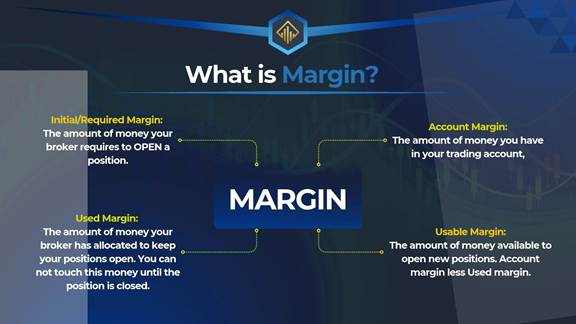
If you ever try to place a trade and see “insufficient margin”, it’s because there isn’t enough usable margin left for that position.
How margin is calculated
\text{Required margin} = \frac{\text{Position size in the quote currency (notional value)}}{\text{Permitted leverage}}
Take EUR/USD at 1.1800. One standard lot is €100,000, which is worth $118,000: that’s the notional value. Here’s the margin needed to open that one lot at different permitted leverage:
| Permitted leverage | Margin for 1 lot of EUR/USD at 1.1800 |
| 200:1 | $590 |
| 100:1 | $1,180 |
| 50:1 (US maximum on majors) | $2,360 |
| 30:1 (UK and EU maximum on majors) | $3,933 |
| 20:1 | $5,900 |
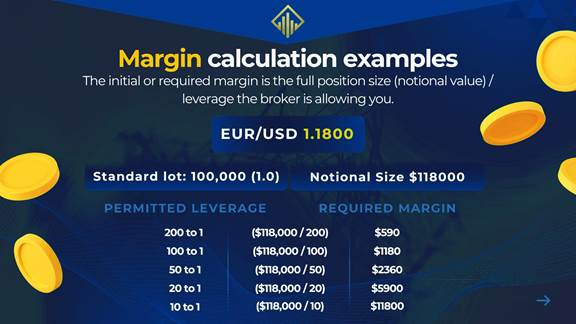
So the same trade ties up ten times more of your account at 20:1 than at 200:1. Remember, that’s about how much is set aside, not how much you should risk.
Other currency pairs. The notional value is always in the quote currency, the second one in the pair. On GBP/AUD, for example, the margin works out in Australian dollars, and your platform converts it into your account currency, usually US dollars, at the current exchange rate. Your platform does all of this for you; just understand the idea.
Margin calls
In the old days a margin call really was a call: the broker rang to say your funds had run low and you needed to deposit more to cover your losses. In the trading pits it was even more direct. You’d be tugged out of the pit by your scruffy jacket and told to put more money in or get out.
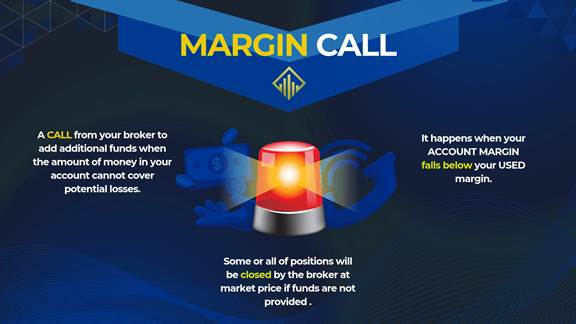
Today it’s automatic. When losses on your open trades eat into your account until it can no longer cover the margin your positions need, your broker steps in. You’ll be warned first, and if things get worse, the broker starts closing your positions at the market price. This is often called a stop-out. You may suddenly find trades closed that you never chose to exit.
In the UK and EU, brokers must close out a retail client’s positions once the account falls to 50% of the margin required, and retail clients get negative balance protection, so you can’t lose more than your account (ESMA). Brokers elsewhere set their own levels, so check yours.
The good news is that if you follow the risk rules in this masterclass, small risk per trade, low leverage and a stop loss on every position, you should never get anywhere near a margin call.
Margin on prop firm accounts
Margin applies on challenge and funded accounts too. Each firm sets its own permitted leverage, and that decides how much margin each trade ties up. On a funded account, though, the daily loss and maximum drawdown limits will almost always stop you long before a margin call would. Treat those limits, not your margin, as the real ceiling on your risk. Leverage and margin rules differ a lot between firms, which is one of the things we compare at Prop Trader Central.
Frequently asked questions
What is margin in forex? A deposit your broker sets aside from your account while a leveraged trade is open. It’s returned when the trade closes.
Is margin a fee? No. It’s not a cost or a charge, just money held as security.
How is forex margin calculated? Divide the position’s value in the quote currency by the permitted leverage. One lot of EUR/USD at 1.1800 with 30:1 leverage needs about $3,933.
What is a margin call? A warning that your account no longer covers the margin your open trades need. If it gets worse, the broker closes positions for you.
What is free margin? The money left in your account to open new trades: your account equity minus the margin already in use.
Watch the lesson
This article goes with lesson 12 of the Prop Trader Central Masterclass, What is Margin. https://youtu.be/UryIY9KBWM8
Trading forex and CFDs involves a high level of risk and may not be suitable for everyone. Most retail accounts lose money when trading CFDs. This article is for educational purposes only and is not financial advice.