

Every trade you take has a cost built in before the market moves a single pip: the spread. I talk about it here mainly in terms of forex, but it applies to anything you buy and sell, from shares to indices to commodities. In this article I’ll explain what the spread is, how to work out what it costs you, and why it changes during the day.
What is the spread?
The spread is the difference between the two prices a broker quotes for any market:
- The bid is the price you can sell at.
- The ask (sometimes called the offer) is the price you can buy at.
The ask is always a little higher than the bid, and the gap between them is the bid-ask spread.
How much does the spread cost you?
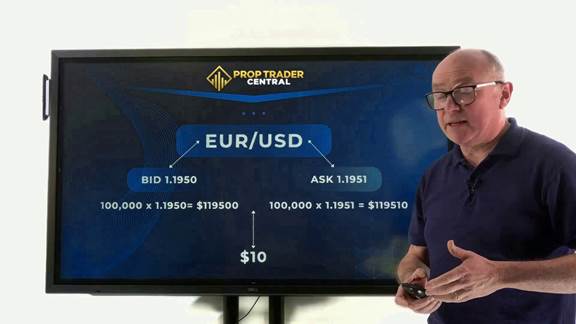
Take EUR/USD. Say the bid is 1.1950 and the ask is 1.1951. That’s a spread of one pip.
To see what that costs, multiply it out by the size of your trade. One standard lot is 100,000 units of the base currency:
| Price | × 100,000 | |
| Bid (sell) | 1.1950 | $119,500 |
| Ask (buy) | 1.1951 | $119,510 |
| Spread | 1 pip | $10 |
So opening one standard lot costs you $10 in spread. The moment you buy, you’re one pip down. The market has to move a pip in your favour before you’re back to break-even, or “scratch” as we used to say on the floor.
This is why the spread matters so much, especially if you trade often or aim for small targets. If you’re new to lots and pips, my article on lots and pips walks through the maths.
Who makes money from the spread?
The spread is how market makers and many brokers get paid. There are two main ways it works:
- Broker spreads. Some brokers add a mark-up on top of the price they get from their liquidity providers. You pay a wider spread, but usually no commission.
- Raw spreads. Other brokers pass you straight through to the prices in the market. You get the tighter raw spread, but you pay a commission on each trade instead.
Neither is right or wrong. What matters is the total cost of each trade, spread plus any commission. We cover choosing between the two in more detail later in the Masterclass.
Spreads are not fixed
You can’t say EUR/USD always has a one-pip spread, or GBP/CAD always has two. Spreads change constantly through the trading session, and they depend on liquidity: how much buying and selling is going on.
Busy pairs have tighter spreads
EUR/USD is the most traded currency pair in the world, at around 21% of all FX turnover according to the Bank for International Settlements’ 2025 survey. All that volume means it tends to have the tightest spreads, which makes it one of the cheapest pairs to trade.
Less actively traded pairs cost more:
- Minors and crosses, such as GBP/NZD, see less volume, so spreads tend to be wider.
- Exotics, such as the Thai baht or South African rand against the Swiss franc, can have spreads that are really quite wide.
Spreads widen when it’s volatile or quiet
Spreads often widen when:
- Big news is due. Around major releases such as US Non-Farm Payrolls, volatility jumps and spreads widen with it.
- Liquidity is thin. Quiet periods, such as the hand-over between sessions or holiday trading, often bring wider spreads.
Watch your stops when spreads widen
This is the part that catches traders out. When the spread widens, the bid and ask move apart even if the market itself hasn’t really moved. If your stop loss is close to the price, a widening spread alone can be enough to take you out of a trade.
So be aware of upcoming news, and think twice about holding tight stops through big releases or quiet, illiquid periods.
The spread and prop firms
On a prop firm account, every pip of cost counts against your profit target and your drawdown limit. A few things help:
- Stick mainly to liquid pairs where spreads are tight.
- Check how your prop firm’s platform charges: wider spreads, commission, or both.
- Be careful trading right around major news, when spreads can blow out.
Frequently asked questions
What is the spread in forex? The difference between the bid price, where you can sell, and the ask price, where you can buy.
How do you calculate the cost of the spread? Multiply the spread by your trade size. On EUR/USD a one-pip spread on one standard lot (100,000 units) costs $10.
Why do spreads widen? Spreads widen when volatility rises, for example around major news, and when liquidity is thin, such as during quiet trading hours.
Which currency pair has the lowest spread? EUR/USD usually has among the tightest spreads, because it’s the most heavily traded pair.
Can a spread trigger my stop loss? Yes. If the spread widens enough, the price you can close at can hit your stop even when the market itself has barely moved.
Watch the lesson
This article goes with lesson 5 of the Prop Trader Central Masterclass, Spread. https://youtu.be/LJw3wsF-Qq8
Trading forex and CFDs involves a high level of risk and may not be suitable for everyone. Most retail accounts lose money when trading CFDs. This article is for educational purposes only and is not financial advice.